Every Animal Compassion NYC post — animals, organizers, action alerts, and small wins from across the five boroughs — kept here where the links actually work. New posts daily on Instagram.
·Plant-Powered NYC
Labor Day's coming, and the American cookout runs on a script: something's on the grill that used to be someone. It doesn't have to be. Charred corn, blistered peppers, thick portobello caps, watermelon with lime and chili, a good bean salad that's better the next day — a plant-powered spread reads as abundance, not sacrifice, and nobody at the table feels lectured. Host the one where the food is the point and nothing had to suffer for it. People remember the meal, not the ideology.
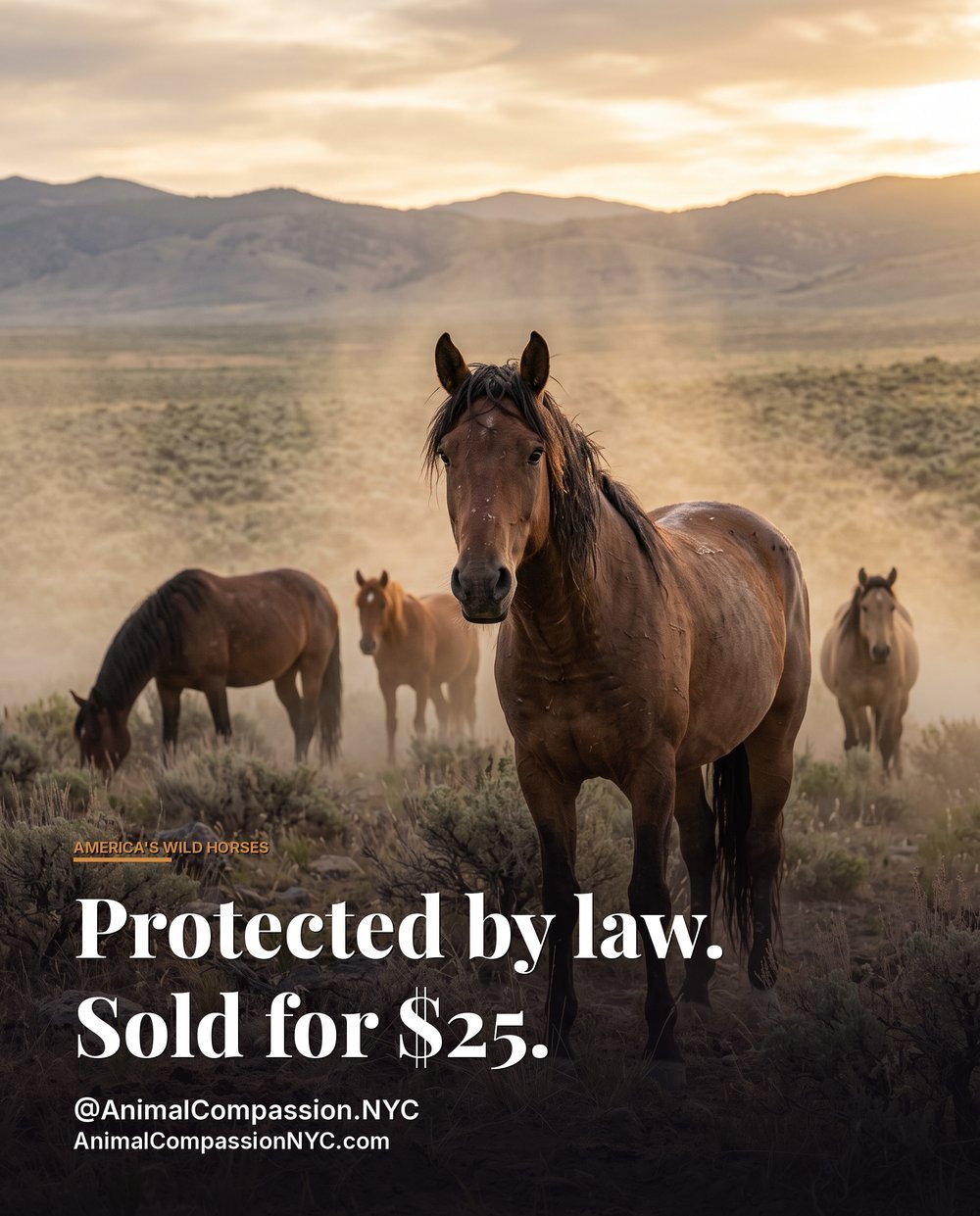
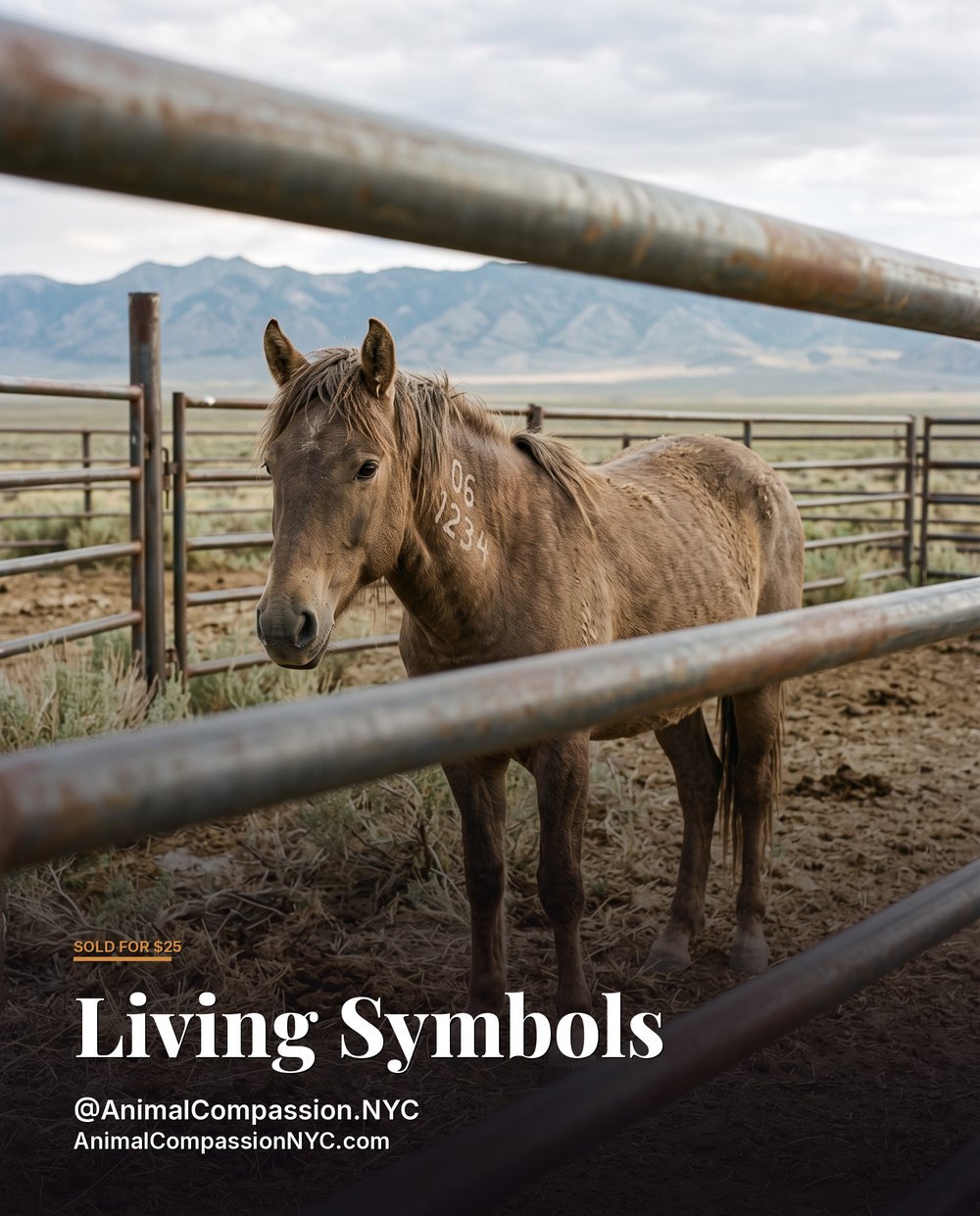
Protected by federal law since 1971. Sold for as little as $25.
The New York Times reported last week that several hundred of America's wild horses have gone out of the Bureau of Land Management's sale program and into slaughter. About 3,700 were sold in 2025 — more than double the usual number. One Ohio livestock trader acquired roughly 500 of them, and the agency approved his application despite warning signs.
Every buyer signs a bill of sale promising not to send the animals to slaughter. That signature is the entire safeguard.
This is what protection looks like when nobody is checking — a law on the books, a form in a drawer, and a horse in a truck facing more than 24 hours without food, water, or rest. Cruelty rarely needs a villain. It just needs a process where no one's actual job is to look.
Congress can end this for good. The appropriations riders that block these sales get renewed year by year, and the current budget request asks to drop them.
Credit where it's due. When an 18-year-old visitor was killed in a horse-carriage crash this June, @peta didn't just grieve loudly — they walked into the City Council hearing with veterinarians, testimony, and a bill number. That pairing is the whole strategy: the outrage gets the cameras, the paperwork changes the law.
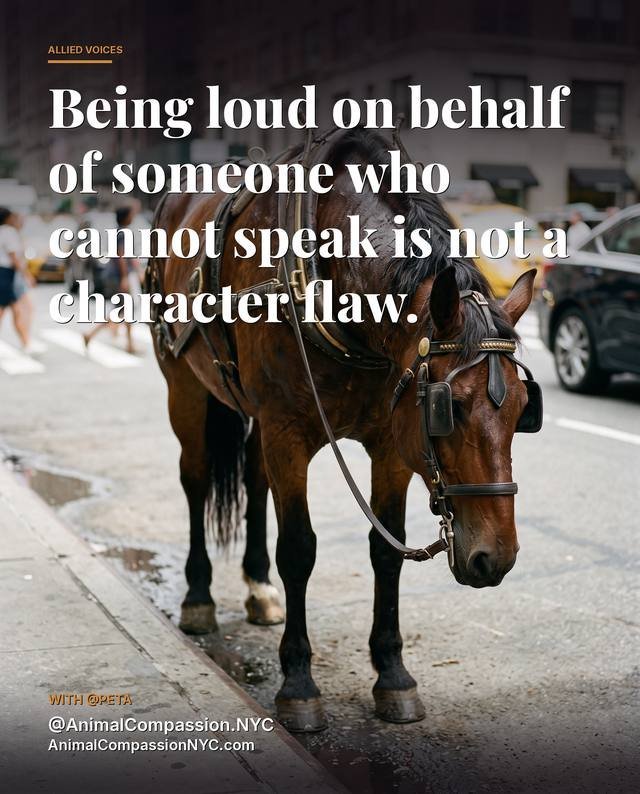
People love to mock PETA for being theatrical. But the theater is how an unglamorous truth — that a horse hauling tourists through Midtown traffic is a welfare problem, not a photo op — finally gets taken seriously. "Romanch's Law" (Intro 943) now has a majority of the City Council behind it, plus the Speaker and the Mayor. Wins like that don't arrive without decades of somebody being willing to be loud first.
Being loud on behalf of animals who can't speak for themselves is not a character flaw. Sometimes it's the only thing that has ever worked.
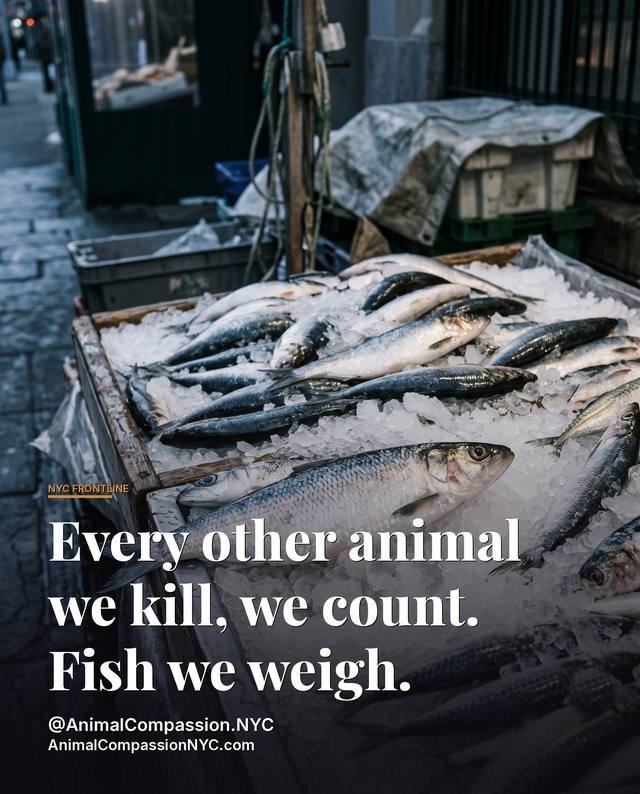
Every other animal we kill, we count. Fish we weigh.
That isn't a rhetorical flourish — it's how the record is actually kept. Cattle, pigs and chickens are tallied by head. Fish are reported in tonnes, which means nobody, anywhere, knows how many individuals are on that ice. The estimates run to the trillions a year, and the range is so wide it amounts to an admission that we never bothered to look.
The science stopped cooperating a while ago. Fish have nociceptors. They learn, they remember, they trade pain off against reward the way mammals do. "Just a fish" was never a finding. It's a permission slip.
That's carnism doing its usual work — sorting the sentient into the edible and the unthinkable, then handing us a reason not to look. Fish are the easy case, because they're cold and silent and we can't read their faces.
Look anyway. Then pick one meal this week that doesn't need the ice.
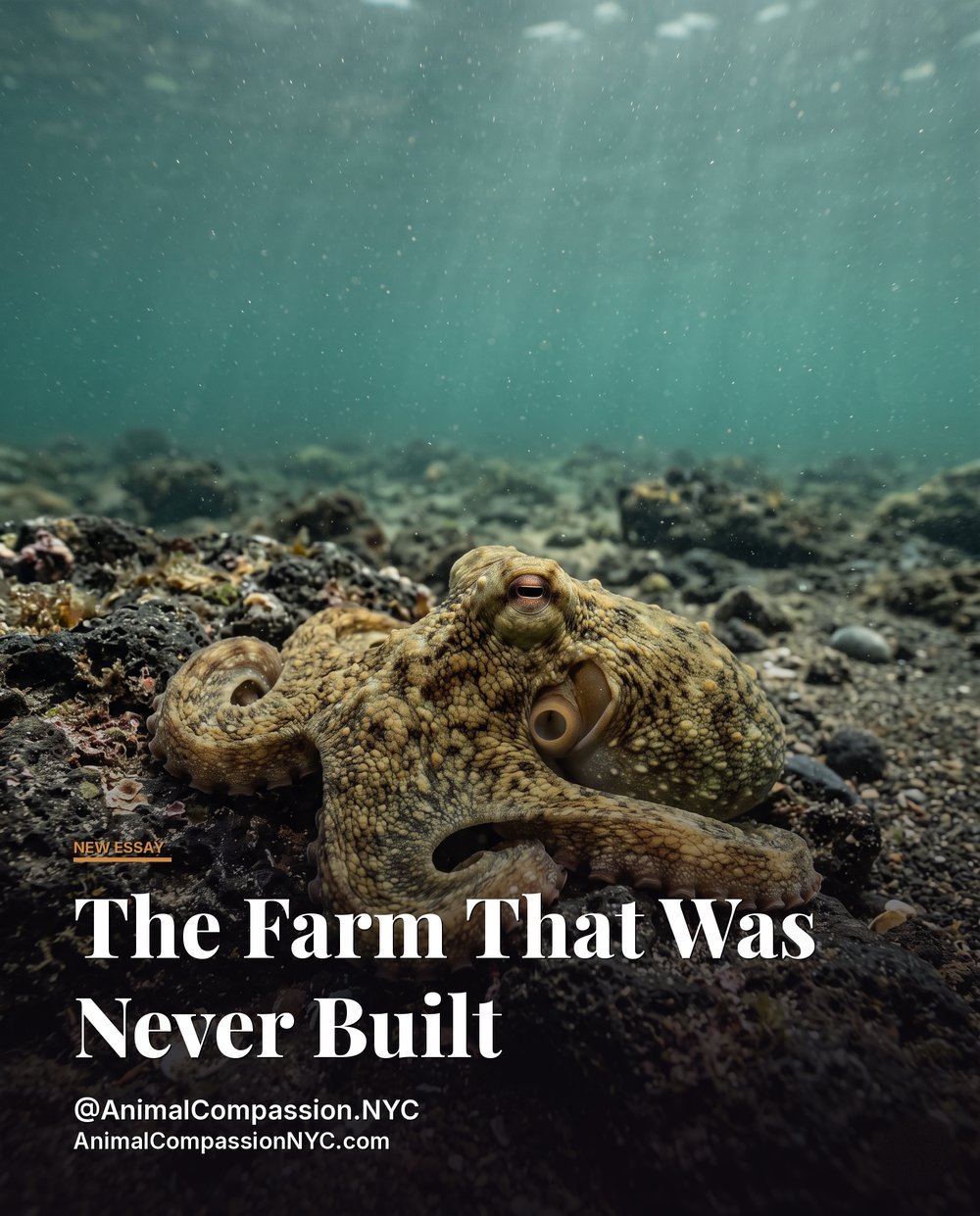
The world's first octopus farm is dead. Nueva Pescanova withdrew its Gran Canaria application on July 23, ending a five-year fight over a facility designed to raise and kill about a million octopuses a year.
Here is what interests me as a psychologist. An octopus has three hearts, no face we know how to read, and most of its neurons in its arms. By every rule we normally use to decide who counts, it should have been hopeless.
People organized anyway — because the farm did not exist yet. There was no habit to protect. A mind is easy to see when nothing depends on not seeing it.
📚 Bastian, B., Loughnan, S., Haslam, N., & Radke, H. R. M. (2012). Personality and Social Psychology Bulletin, 38(2), 247–256.
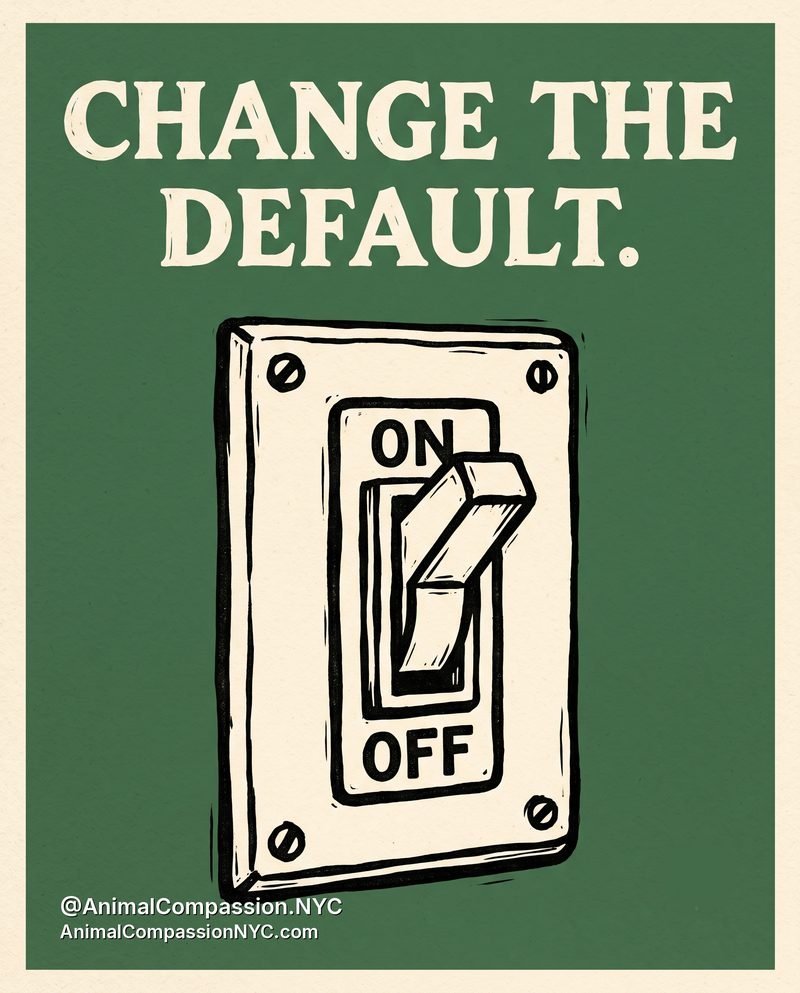
The most powerful animal-welfare lever isn't persuasion — it's defaults. When institutions make plant-based the standard option (schools, hospitals, city events), participation soars without anyone being lectured. Ask your workplace, your kid's school, your co-op: what's the default here, and who decided? Changing one default outperforms a hundred arguments.
The Cambridge Declaration on Consciousness is one page long. It was signed at Churchill College in July 2012, at a conference on consciousness in human and non-human animals, and its central sentence is not hedged: humans are not unique in possessing the neurological substrates that generate consciousness. Mammals. Birds. Octopuses.
What strikes me, rereading it, is how little argument followed. No serious rebuttal ever came. The document simply went quiet — filed, cited now and then, and otherwise left alone while everyone went back to lunch.
Twelve years later the circle got wider rather than narrower. The New York Declaration on Animal Consciousness, launched at NYU in 2024, extends the claim to reptiles, amphibians, fishes, cephalopods, decapod crustaceans, and insects — not as certainty, but as a realistic possibility strong enough that ignoring it in policy is itself a choice. Hundreds of researchers have now signed it.
In at least one place it changed a law. A commissioned review of the evidence on cephalopod molluscs and decapod crustaceans led the United Kingdom to write octopuses and crabs into the Animal Welfare (Sentience) Act 2022. The evidence was considered good enough to legislate on.
So the gap here is not knowledge. We have known, in the strong scientific sense of the word, for more than a decade. What has not moved is attention — and attention is a psychological problem, not an evidentiary one. A fact does not get past a mind that has a reason not to receive it. That is why argument so rarely converts anyone, and why noticing does.
Read the declaration. It takes two minutes. Then sit with the fact that you already knew.
Swipe through for the evidence — full citations on the last pane.
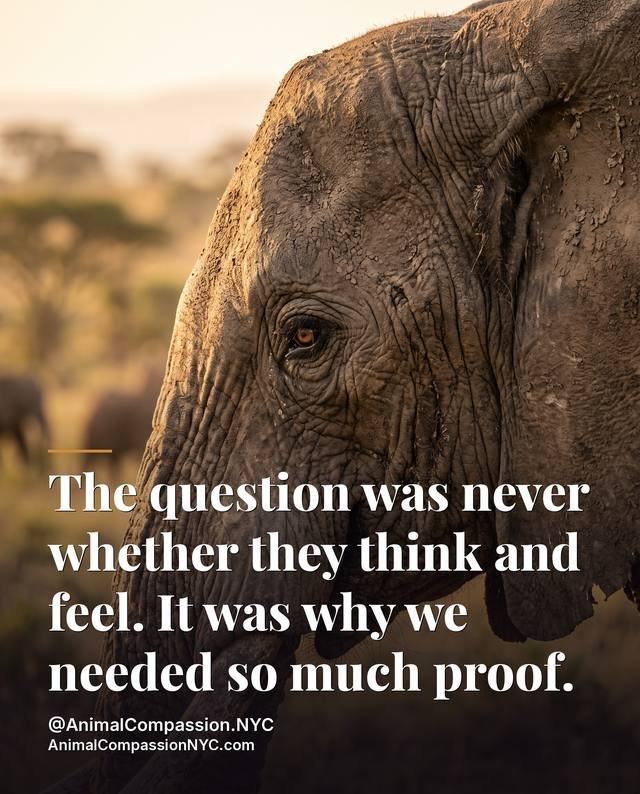
Carl Safina flipped the question in Beyond Words. Not whether animals think and feel — but why human egos seem "so threatened by the thought that other animals think and feel."
That flip moves the subject from them to us. The evidence on elephant grief, pig anticipation, crow planning has been stacking up for decades. What needs explaining now is why we keep demanding more of it — why the bar for an animal mind sits so much higher than the bar for anything else we are willing to believe.
The honest answer is that recognizing somebody in there costs us something. It is easier to require impossible proof than to change the plate.
You already know what you saw the last time an animal looked back at you. Trust it, and say so in the comments.
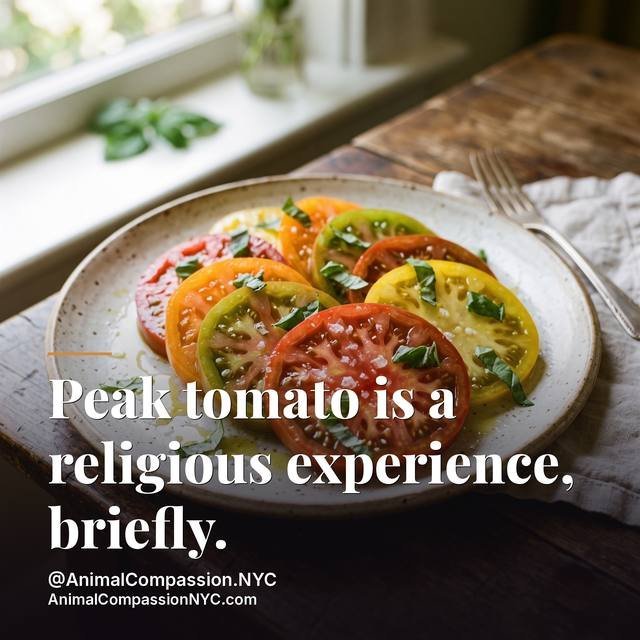
For about three weeks in late August, a New York tomato needs nothing. Not a recipe, barely a knife. Thick slice, flaky salt, good olive oil, torn basil if you're feeling fancy — that's lunch, and it beats most things you'd pay for. The whole plant-powered case fits on that plate: the best food of the summer never cost an animal a thing. Get to a greenmarket before the season turns, and eat the tomato standing over the sink like you mean it.
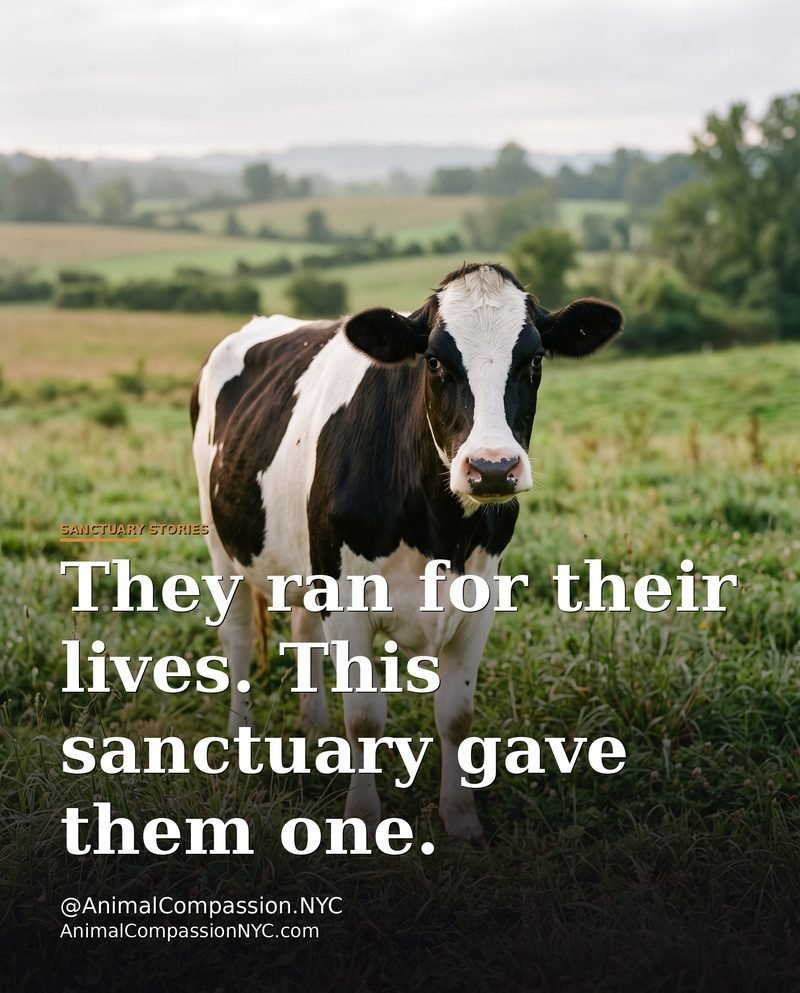
The animals who made the news running loose through New Jersey didn't get lucky. Someone decided they mattered.
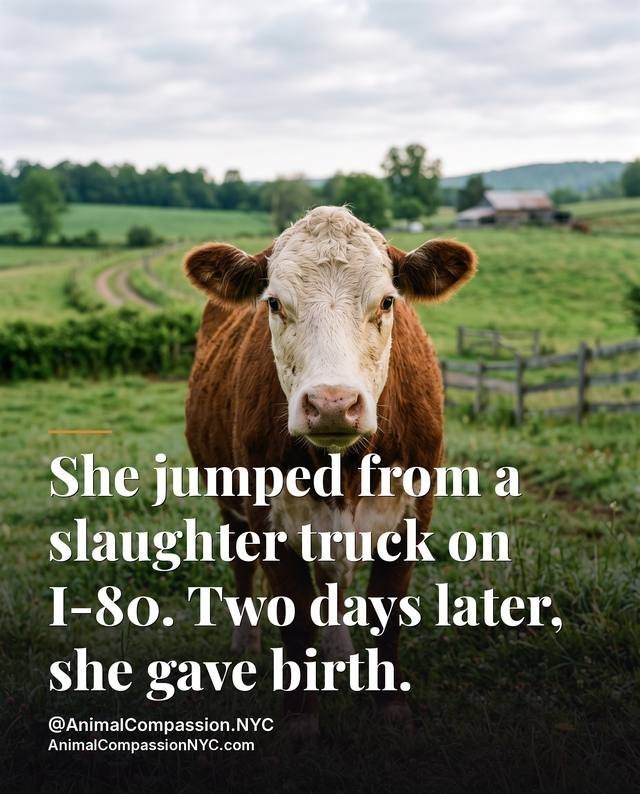
Skylands Animal Sanctuary & Rescue in Wantage, NJ is where those stories end well. Founder Mike Stura built it around the ones who bolted — off trucks, out of yards, down the highway. Brianna, a Holstein, leapt from a moving slaughter truck onto Route 80 nine months pregnant. Two days later she gave birth to a calf named Winter — in a barn, not a kill line. That calf grew up in a pasture.
Every animal there ran toward the same thing: room, safety, a life that was theirs. The only difference between the ones who make it and the ones who don't is whether a person decides their run for freedom meant something.
Follow @skylands_sanctuary — and the next time an animal makes a break for it on the evening news, root for the ending where they win.
A wild horse can be sold by the federal government for twenty-five dollars.
The New York Times reported Thursday that the BLM's sale program has been moving federally protected mustangs to buyers who resell them within days into an export pipeline ending at slaughterhouses across the border.
Call it a loophole and you let everyone off. Congress banned the killing and the slaughter-bound sale in the same sentence, and has renewed that ban every year since 2010. The agency just stopped checking who it sells to.
The 1971 law calls these horses “living symbols of the historic and pioneer spirit of the West.” It never said they could suffer. Fifty-five years later, that's the part nobody enforces.
📚 Bandura, A. (1999). Moral disengagement in the perpetration of inhumanities. Personality and Social Psychology Review, 3(3), 193–209.
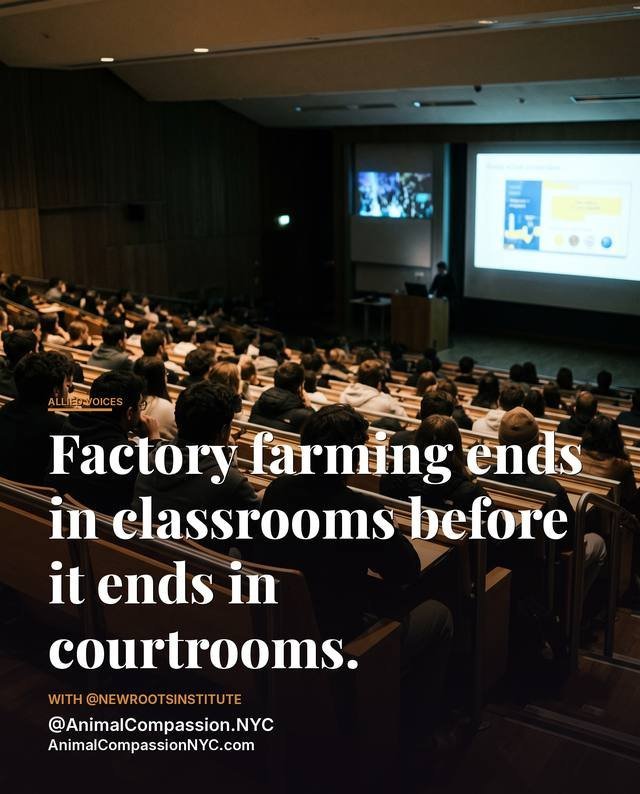
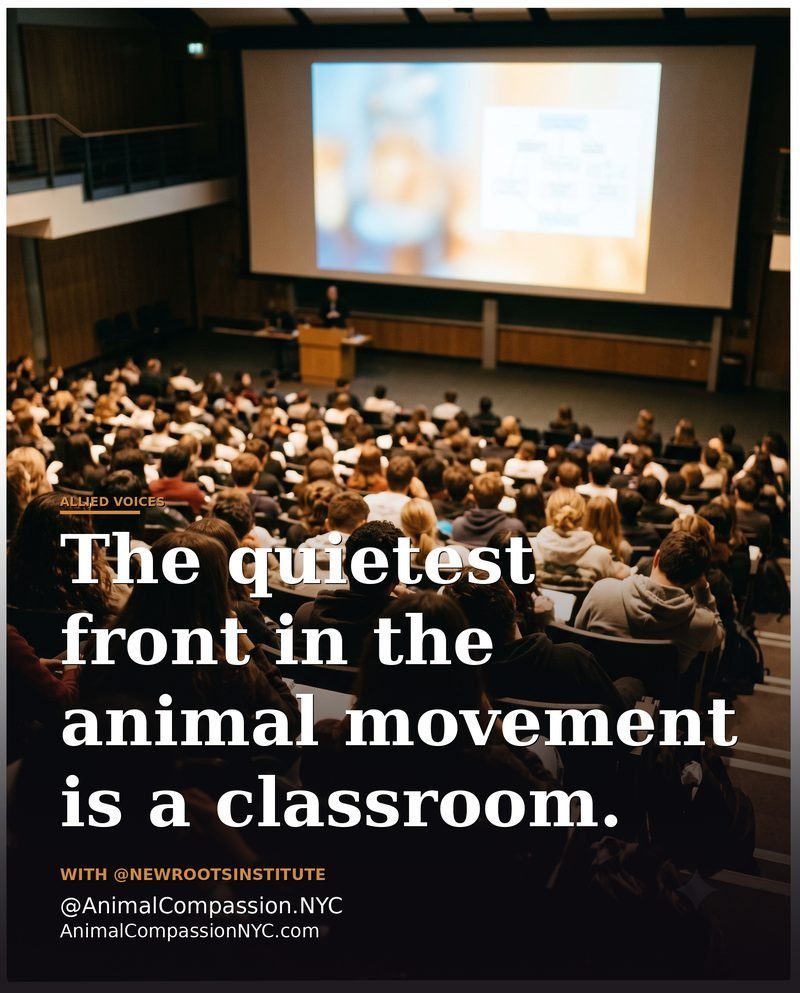
The loudest animal advocacy gets the footage. The most durable kind gets a syllabus.
New Roots Institute (@newrootsinstitute) — formerly the Factory Farming Awareness Coalition — doesn't chase virality. Its people walk into high school and college classrooms and teach students how the food system actually works: where what's on the tray comes from, who pays for it, and what a person can do about it. No shock reels, no shouting — just the slow, methodical work of changing who's in the room ten years from now.
Movements don't turn only on protests and petitions. They turn on the eighteen-year-old who hears the whole story for the first time and never quite unhears it. That's the quiet front, and it's where a lot of tomorrow's compassion is being planted today.
Credit where it's due: @newrootsinstitute has spent more than a decade doing the unglamorous classroom work most of us never see. Give them a follow — and if you teach, or know someone who does, see whether their lessons belong in a classroom near you.
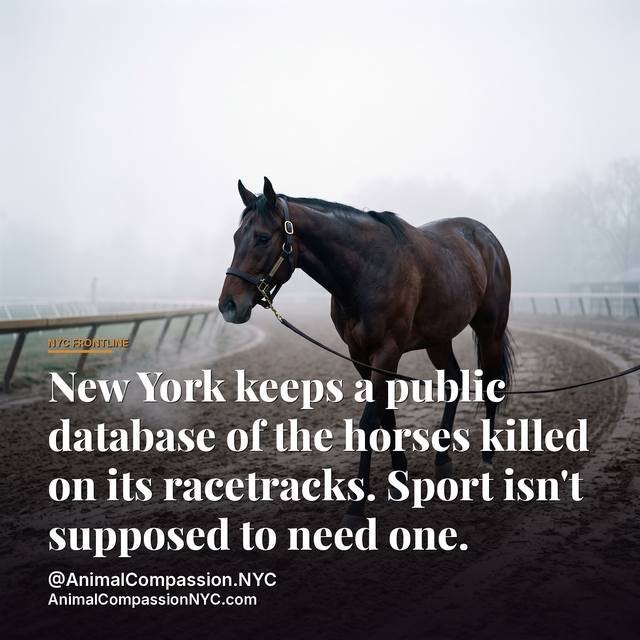
New York State keeps a public database of the horses that die at its racetracks. Sit with that for a second — the sport needs a body count, and the state publishes it.
The Saratoga meet runs all summer into Labor Day, and the toll doesn't only land on race day. Horses are destroyed in training too, some of them two-year-olds who never reached a starting gate. “Catastrophic injury” is the industry's tidy phrase for it. These are animals bred for a body that outruns its own legs, run young for money that was never theirs, retired by a needle when the legs give out.
You can love the pageantry and still refuse to look past the breakdowns. Those aren't the same thing — and the horses never got a vote on either.
Read the state's own record:
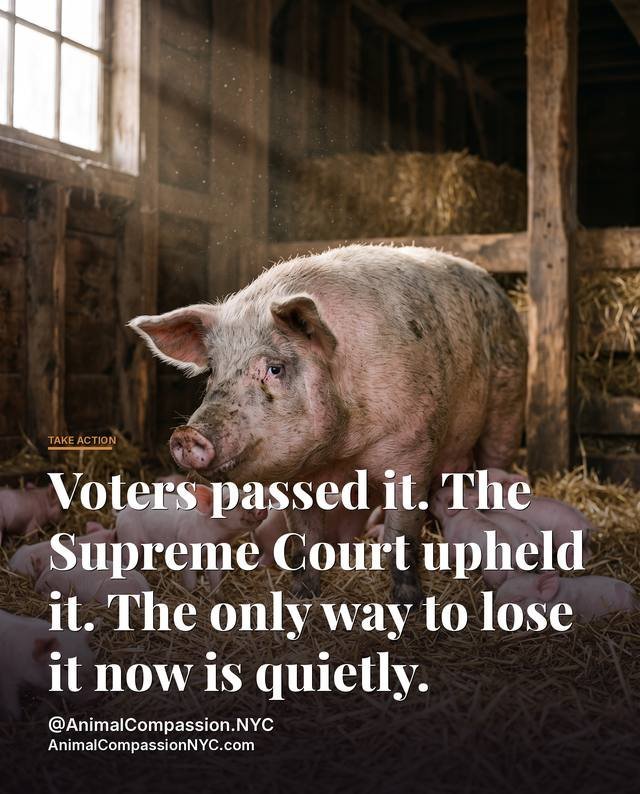
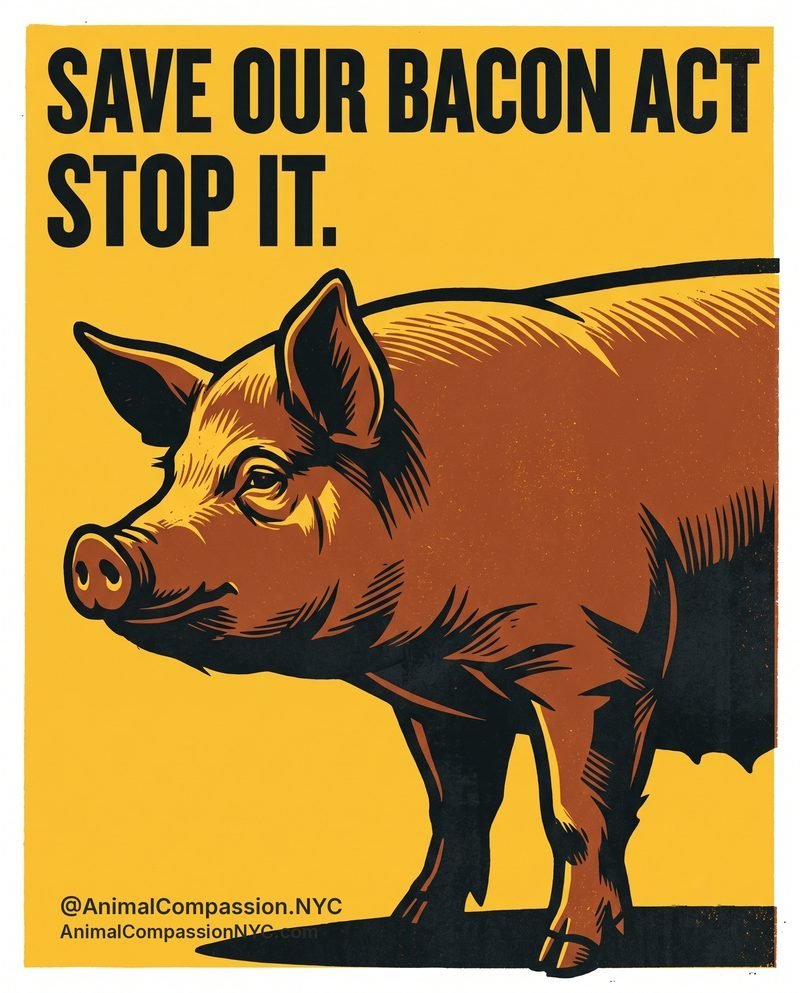
Voters passed Prop 12. The Supreme Court upheld it. The only way to lose it now is quietly.
Prop 12 set minimum space standards for farm animals — enough room for a mother pig to stand up and turn around, and not much more. The pork lobby's answer is the Save Our Bacon Act, which would nullify it nationwide along with Massachusetts' Question 3. That language passed the House inside its farm bill back in April. The Senate Agriculture Committee left it out of its own draft in June and didn't add it at the August 6 markup — where the whole bill then stalled on a 10–11 vote and never made it out of committee.
So nothing is settled. This is how state animal-welfare laws actually die — not in a floor fight anyone is watching, but in a conference room, months later, where a provision quietly gets traded back in. The people who wrote it are patient. They only have to win once.
Tell your senators you're watching the farm bill, and that Prop 12 stays.
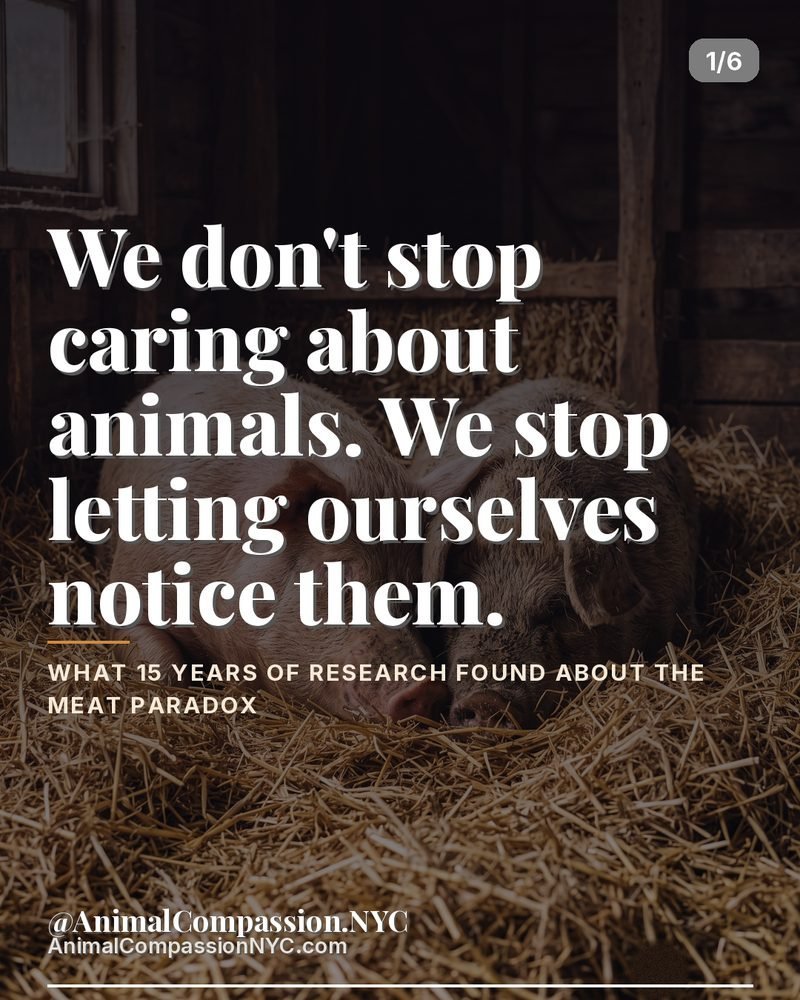
Almost nobody wants animals to suffer. Almost everybody eats them. Psychologists have a name for that gap — the meat paradox — and about fifteen years of experiments now describe how the mind closes it.
The finding that reorganized how I think about this: the belief moves, not the behavior. When people are told an animal is food, they rate it as less able to think, feel, and suffer. Bastian and colleagues showed the downgrade happens in advance of eating — told they'd be having meat, participants pre-emptively withdrew mind from the animal. That isn't sloppy reasoning. It's motivated reasoning doing exactly the job it's for: protecting a behavior you don't intend to change. A 2024 registered replication found it holds.
Which is why argument so rarely works. Hand someone a fact that threatens the behavior and the machinery that dims the animal's mind just runs harder. You can win the exchange and lose the person.
But the mechanism is symmetrical, and that's the hopeful part. The same literature showing mind-denial narrow the moral circle shows that closing the human–animal divide widens it. Not by making people feel guilty — by making the animal harder not to notice. A face. A name. A pig who chose where to sleep.
So the ask is smaller than you'd expect. Don't argue with anyone this week. Put one animal in front of them and get out of the way.
Swipe through for the studies — full citations on the last pane.
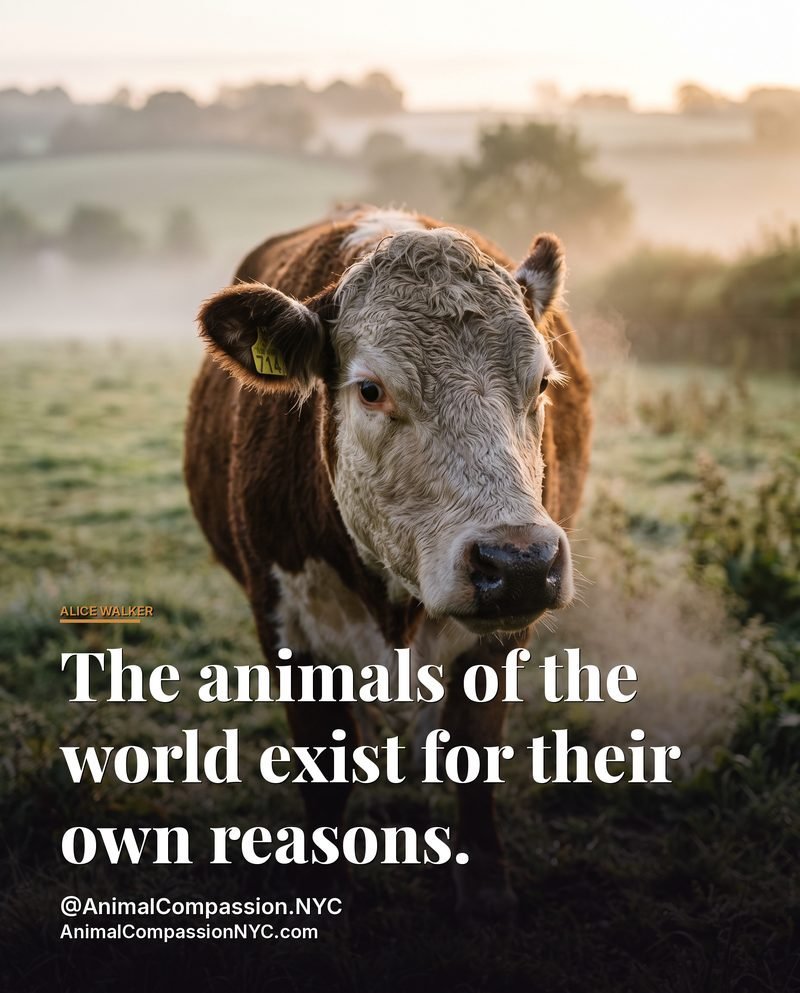
It isn't a plea. It's a claim about the world.
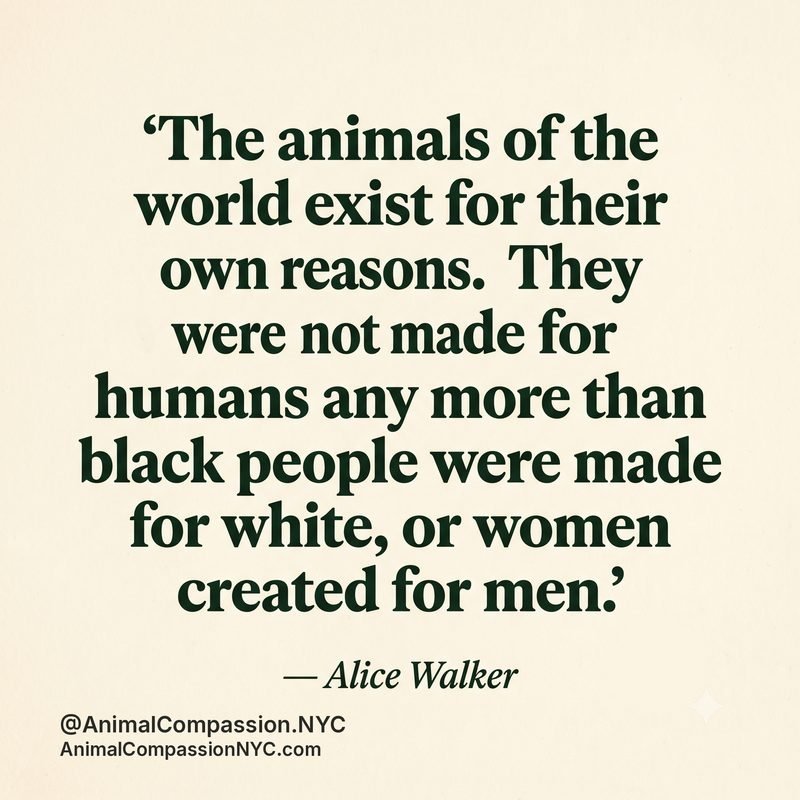
Alice Walker opened her preface to Marjorie Spiegel's The Dreaded Comparison with the line that "the animals of the world exist for their own reasons." No appeal to sympathy. No photographs of suffering. Just a statement about what is true — that the cow standing in a field at dawn has a point, and the point isn't us.
Almost every argument we have about animals is really an argument about that one sentence. If they exist for us, everything downstream is a management question: cage sizes, welfare labels, humane certification. If they don't, it becomes a justice question, and the arithmetic gets much less comfortable.
The uncomfortable part is that most of us settled it long before anyone asked.
Read it once more, slowly. Then tell us in the comments what would have to change if you took it seriously.
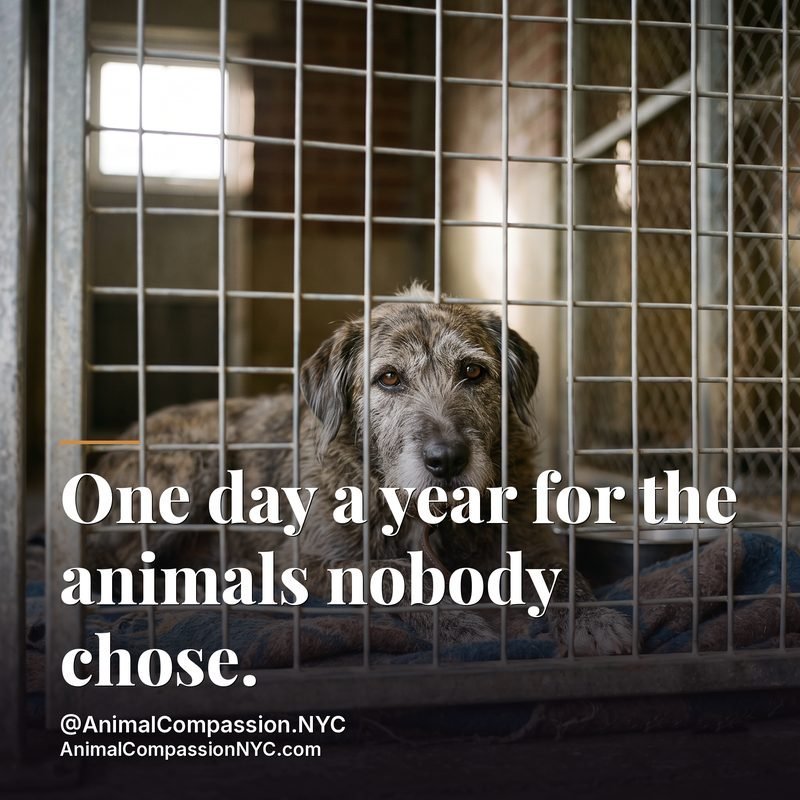
International Homeless Animals Day. Every third Saturday in August, shelters hold candlelight vigils for the ones who didn't make it out — and adoption events for the ones who still can. The numbers are easy to look away from: millions of dogs and cats enter U.S. shelters every year, and the ones who wait longest are the old, the black-coated, the medically complicated — the least "adoptable" by our arbitrary math. Compassion that stops at the cute and the young isn't really compassion; it's preference. If you can adopt, adopt the overlooked one. If you can't, foster, volunteer, or just share a shelter's post today — visibility is most of the fight.
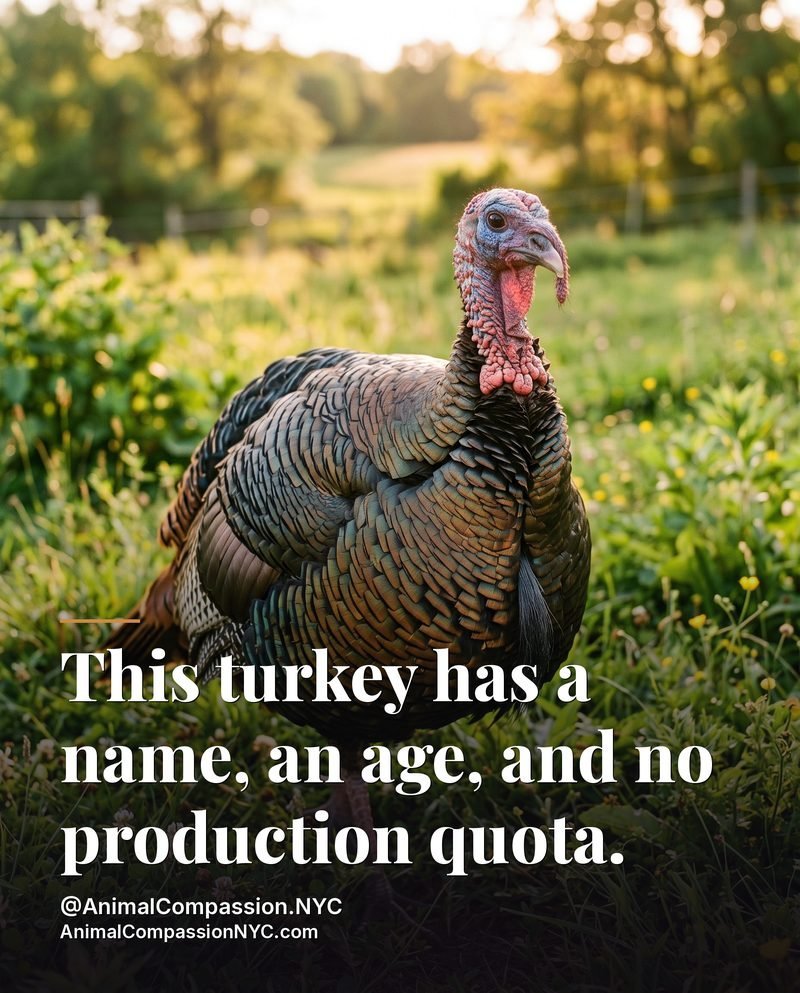
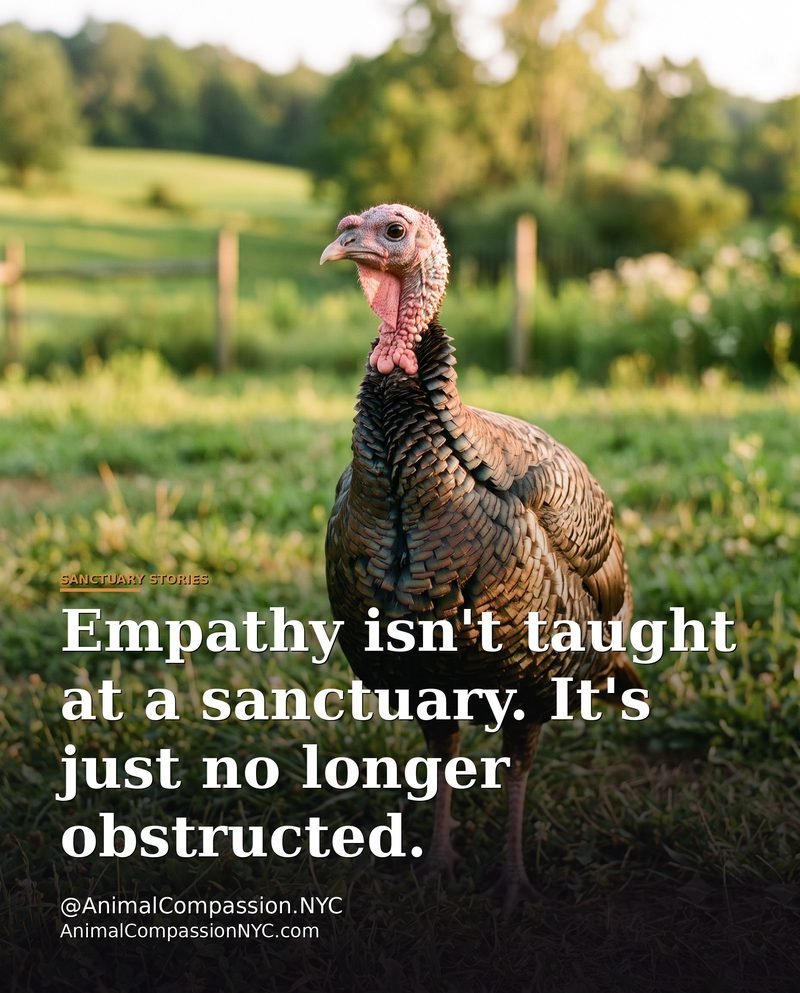
You can't argue anyone into caring about a turkey. You can only introduce them to one.
Catskill Animal Sanctuary in Saugerties sits about ninety minutes north of the city, home to hundreds of rescued farm animals. Ask a visitor what they remember and it's never a statistic — it's the moment a turkey leaned into them, or a horse chose their company over the open field. Empathy isn't taught at a sanctuary; it's just no longer obstructed. Meet one animal whose life was spared and the abstraction "farm animal" quietly comes apart in your hands.
They run guided weekend tours right through late November — you book ahead and go. Bring the friend who isn't sure yet.
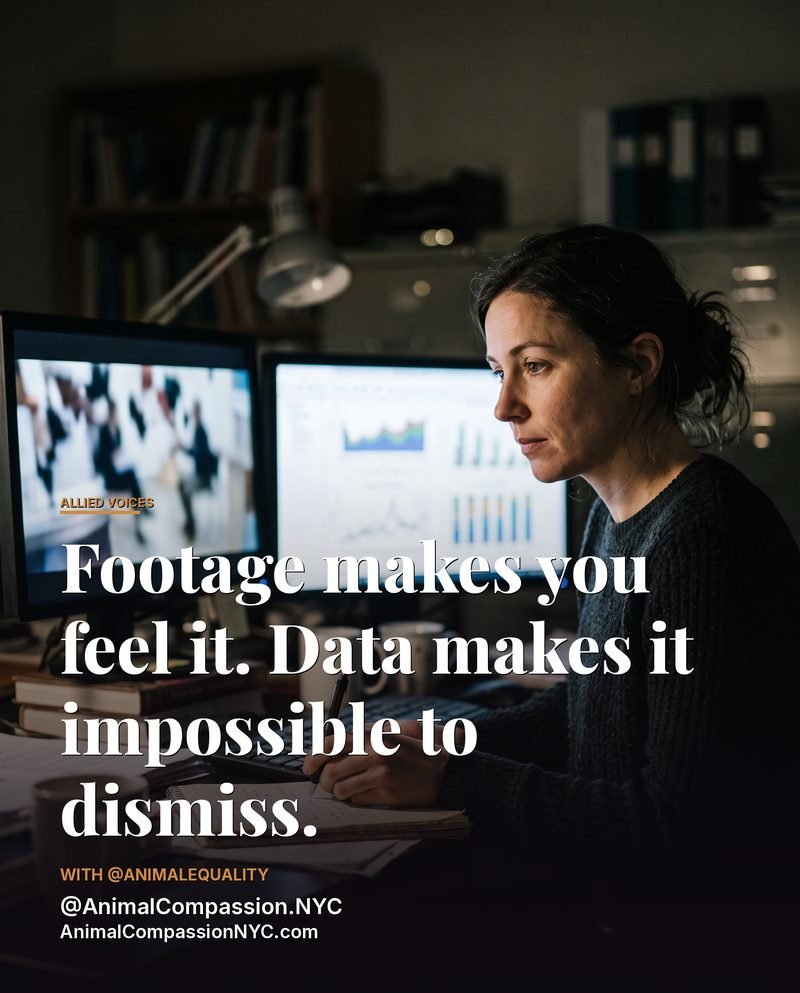
Footage makes you feel something. Feeling is not a strategy.
@animalequality has filmed inside more than 900 factory farms and slaughterhouses across 13 countries — but what sets them apart is that they treat advocacy as an empirical question and not only a moral one. Which message actually moves people. Which campaign actually changes a supply chain. The evidence sits right next to the image, and the two together are much harder to wave away than either one alone.
That pairing is rarer in this movement than it should be. Compassion that did its homework is the kind that survives contact with a boardroom.
Follow @animalequality — then put your own compassion somewhere it compounds:
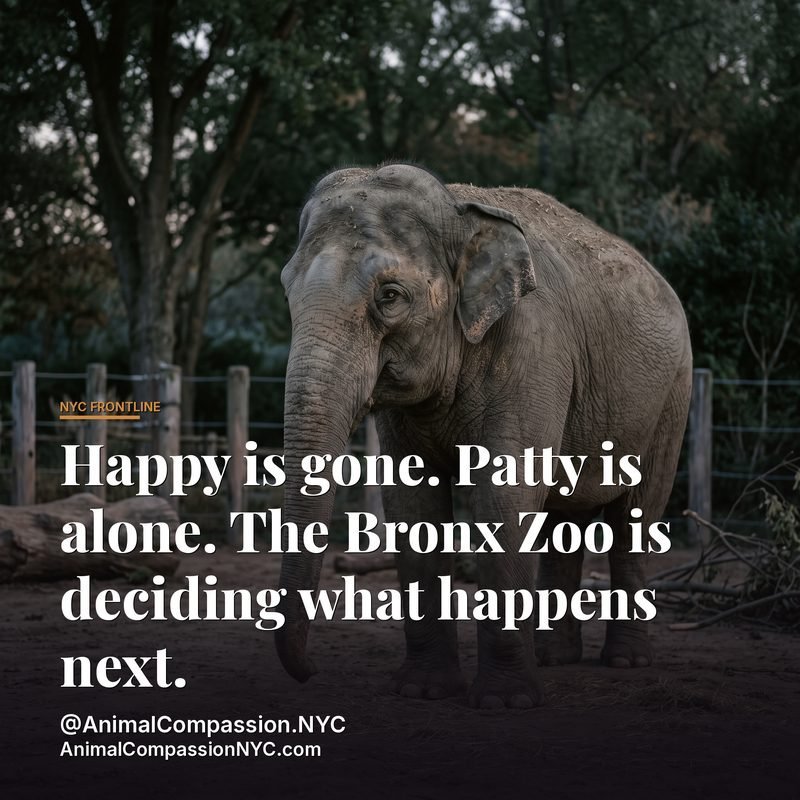
It's World Elephant Day, and New York's chapter of it is a decision being made right now.
Happy died at the Bronx Zoo in May, at 55, after roughly two decades without another elephant beside her. She was the elephant who passed the mirror self-recognition test — the first in history to have a habeas corpus petition argued before a state's highest court. She lost, 5–2.
Patty is 57. She arrived in 1973. She is now the only elephant left in New York City, and she is alone. The Wildlife Conservation Society says it is weighing whether to move her to The Elephant Sanctuary in Hohenwald, Tennessee — 3,000 acres, twelve elephants, company. And a City Council bill, Int. 0590-2026, would require any elephant kept in this city to have at least fifteen acres and a herd to belong to.
Elephants aren't solitary animals who happen to be alone. Solitude is an injury we've decided not to call one.
Happy's question was whether a mind that knows itself can be property. Patty's is simpler — does she get to spend her last years with her own kind? That one still has a good answer available.
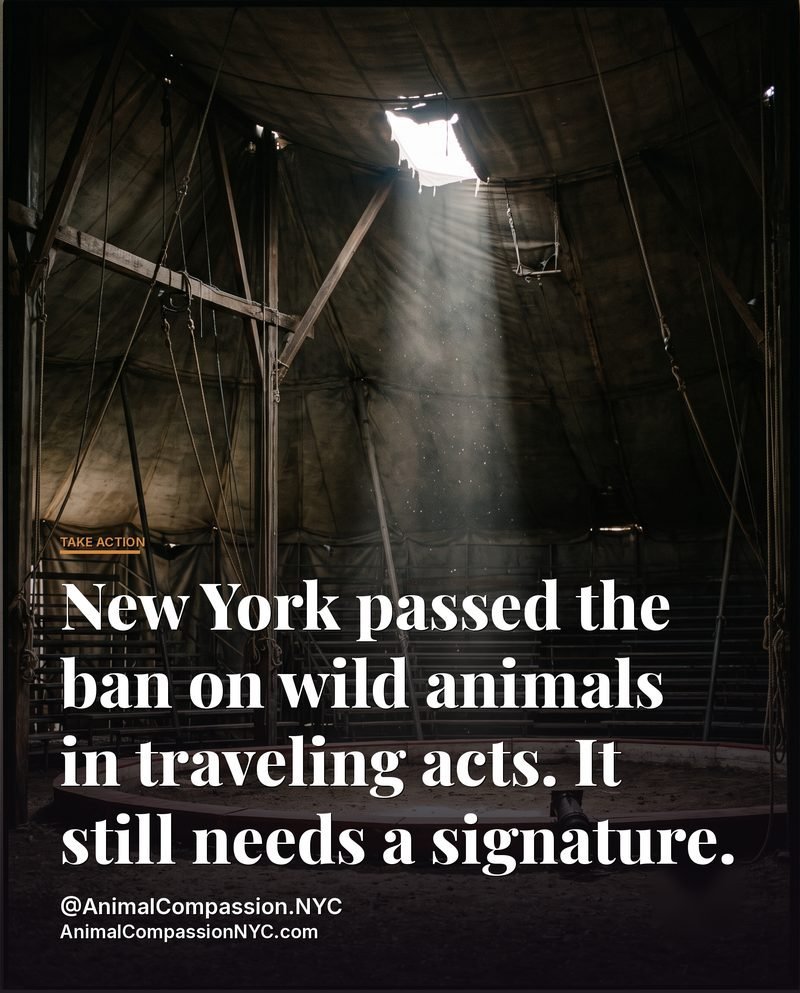
New York already passed this one. What's missing is a signature.
S.3629-A / A.5850 bars big cats, bears, primates, kangaroos and wallabies from traveling animal acts — the trucks, the trailers, the folding cages that go up in a parking lot on Friday and come down Sunday night. The Senate cleared it 53–9 in May. The Assembly cleared it in the spring. It still hasn't been signed.
Notice how narrow the bill is. Zoos, aquariums and permanent facilities are untouched. The only thing it ends is hauling a wild animal from town to town so it can perform for a few minutes under the lights — which is probably why Republicans and Democrats ended up on the same side of it. There is no serious version of the argument that the trailer is good for the bear.
Signed, it takes effect December 31. Unsigned, it's nothing. Ask her to sign it.
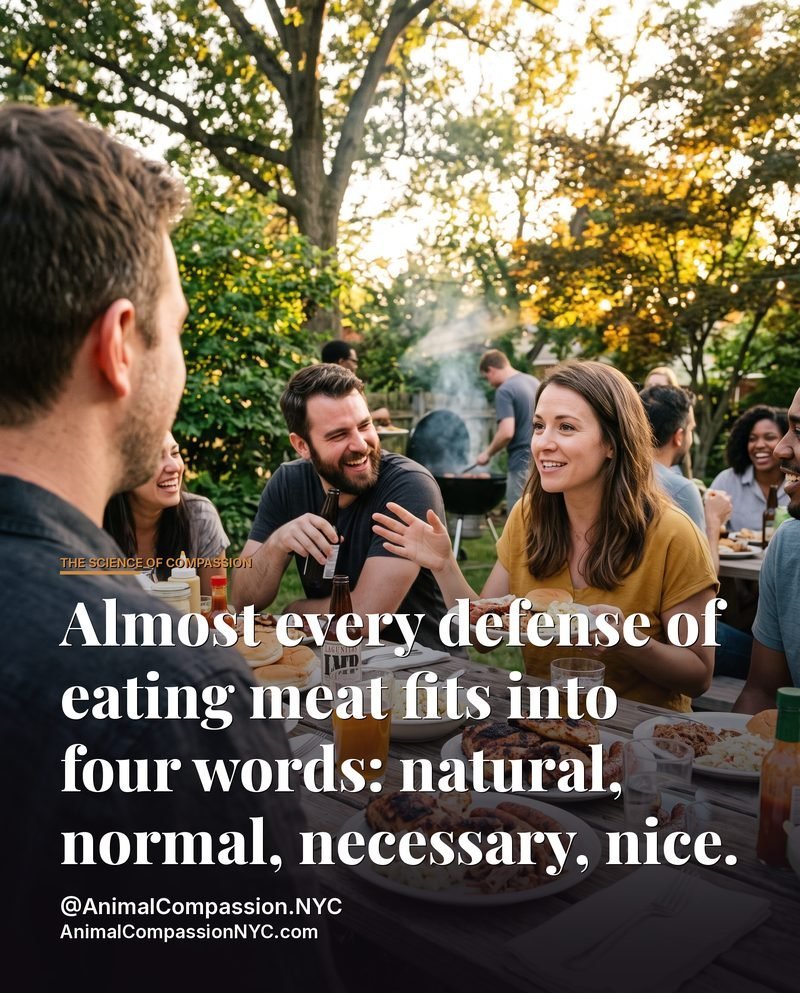
Almost every defense of eating meat fits into four words.
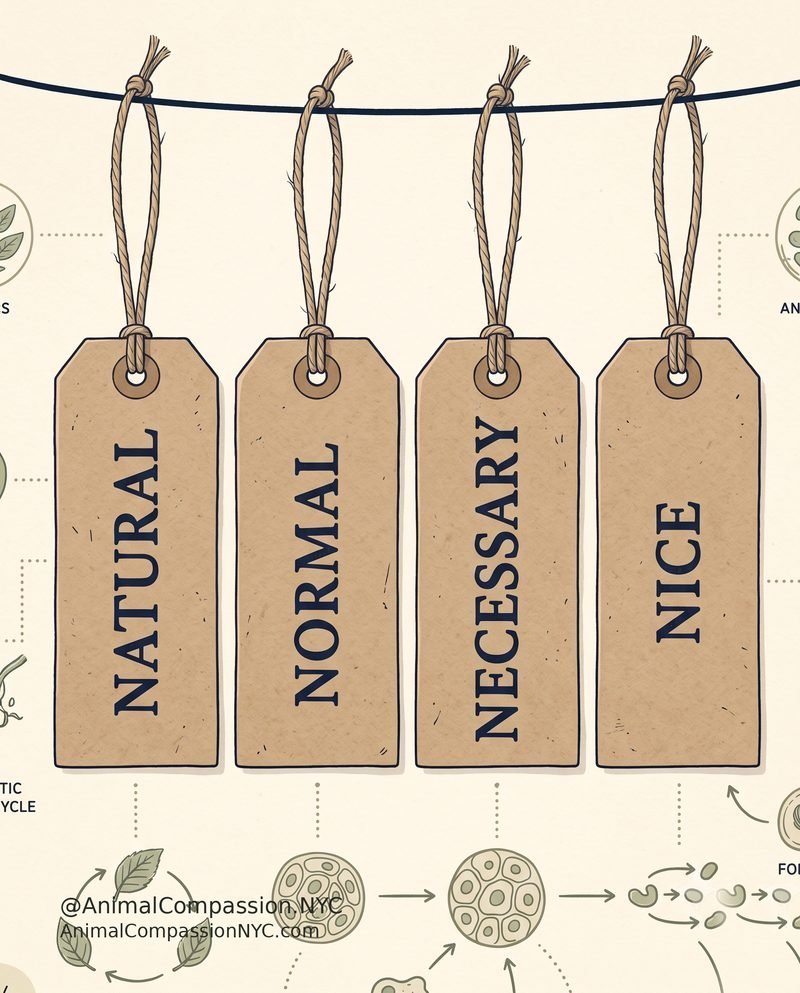
When people explain why they eat animals, the reasons collapse into four buckets with striking reliability — it's natural, it's normal, it's necessary, it's nice. Piazza and colleagues named them the 4 Ns, and found that the people who lean on them hardest report less concern for animals and less guilt about eating them.
Naming the script isn't a gotcha. It's a mirror. Most of us absorbed these four words long before we were old enough to question them, which is exactly why they feel like common sense instead of an argument.
Notice which of the four you reach for first. That one is carrying the most weight — and it's the one worth pulling on.
Save this for the next time the backyard conversation turns.
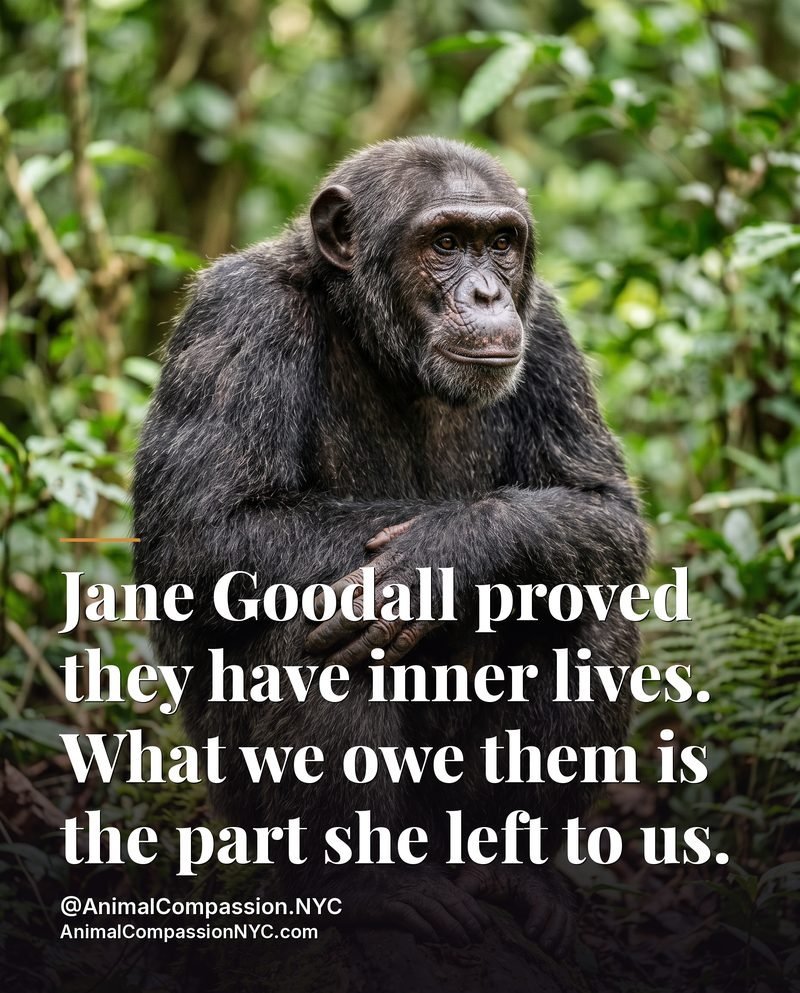
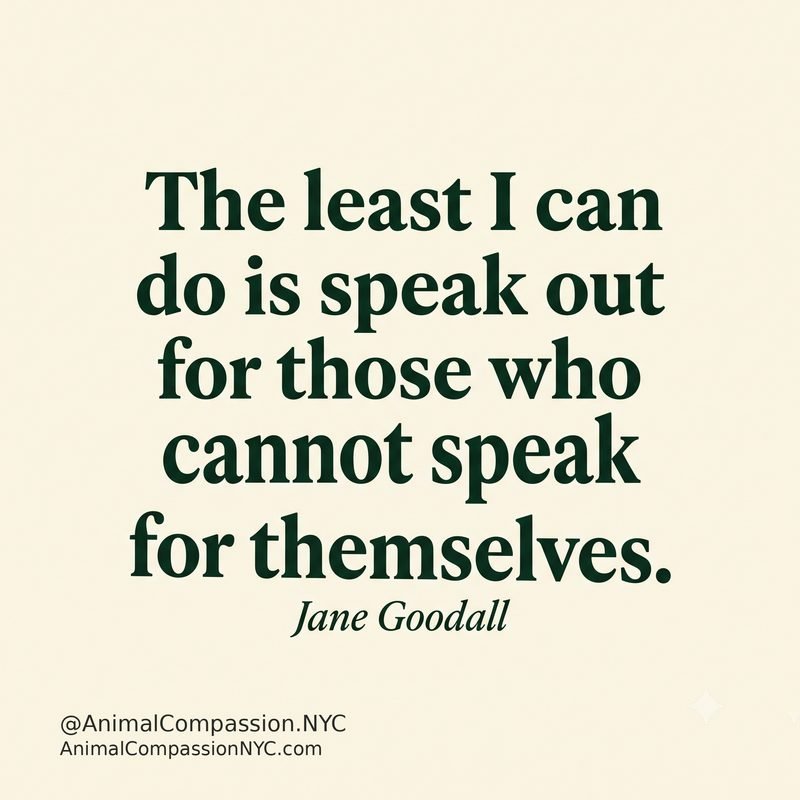
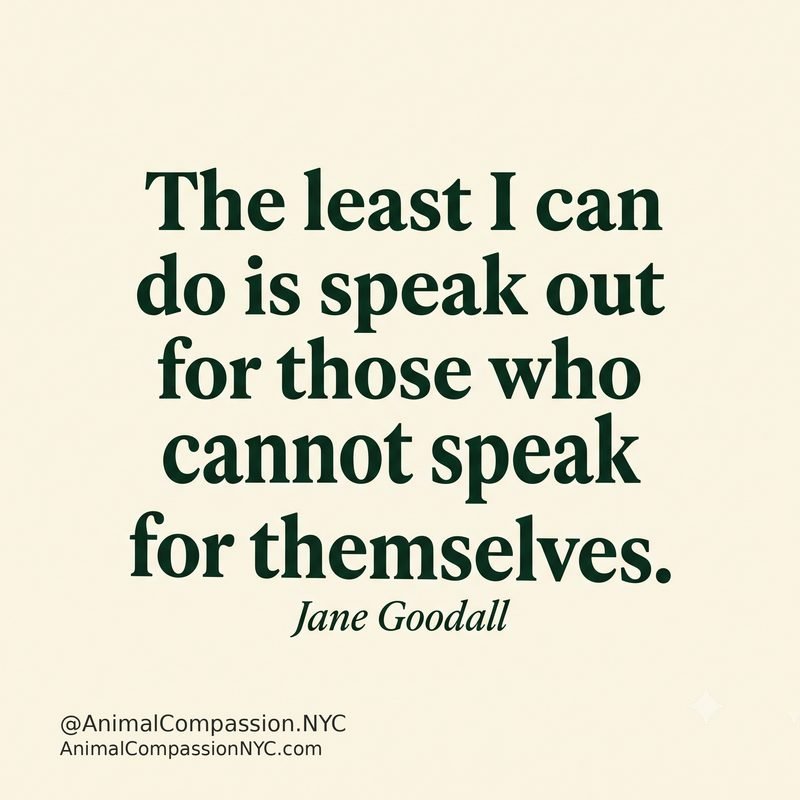
"The least I can do is speak out for those who cannot speak for themselves." — Jane Goodall. She spent a lifetime proving that the line between us and them was always thinner than we were taught. The voice she's talking about isn't loud; it's just steady, and it's available to all of us.
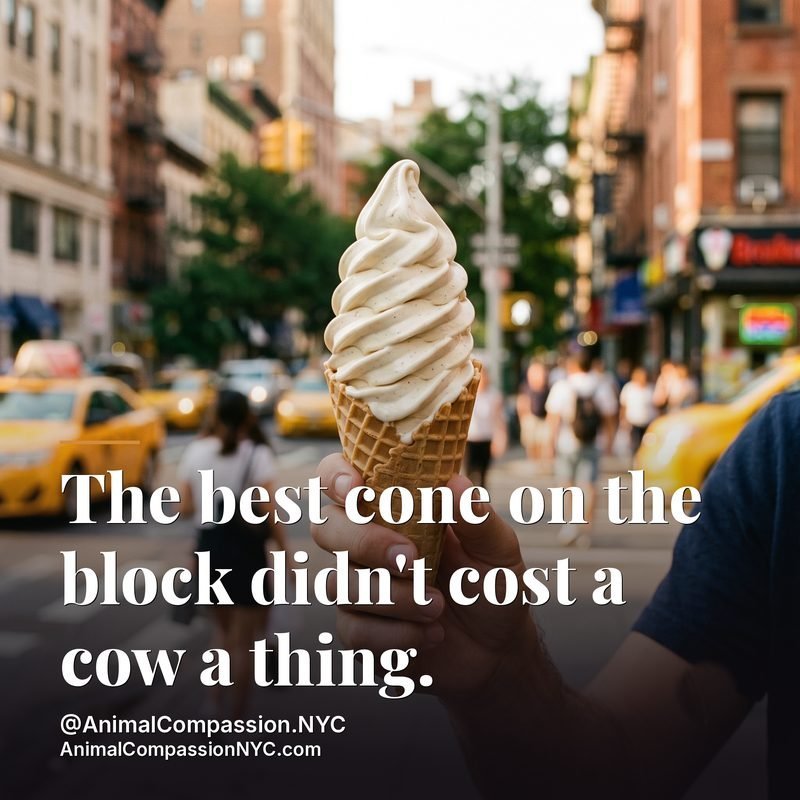
It's August, it's brutal, and nobody should have to choose between cooling off and their values.
The city is thick with plant-based scoops now — oat-milk soft serve, coconut gelato, cashew-cream pints that quietly end the 'but I could never give up dairy' conversation in one bite. And here's what that phrase hides: 'give up' treats dairy as ours to keep, when the milk was never meant for us — it's meant for a calf who was taken so we could have the carton. A plant-based scoop skips all of that, and still tastes exactly like a New York summer.
So: no sacrifice, no cow-and-calf math, no compromise. Just a good cone on a hot block.
Drop your favorite NYC vegan ice cream spot below — somebody scrolling past needs the rec.
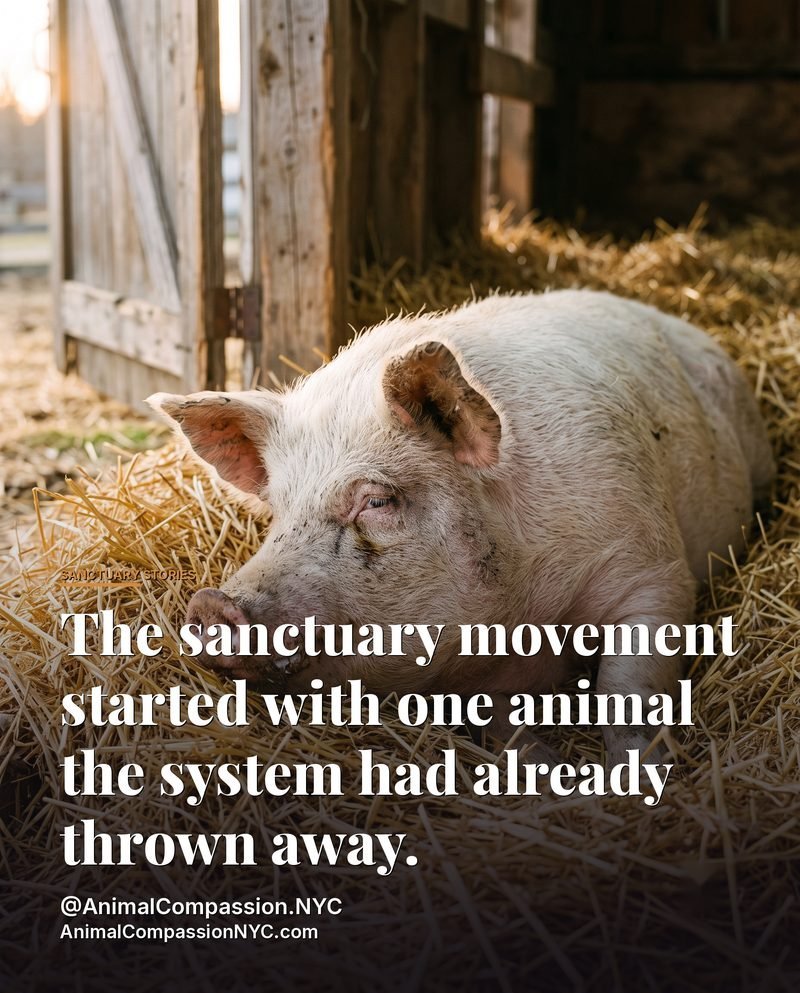
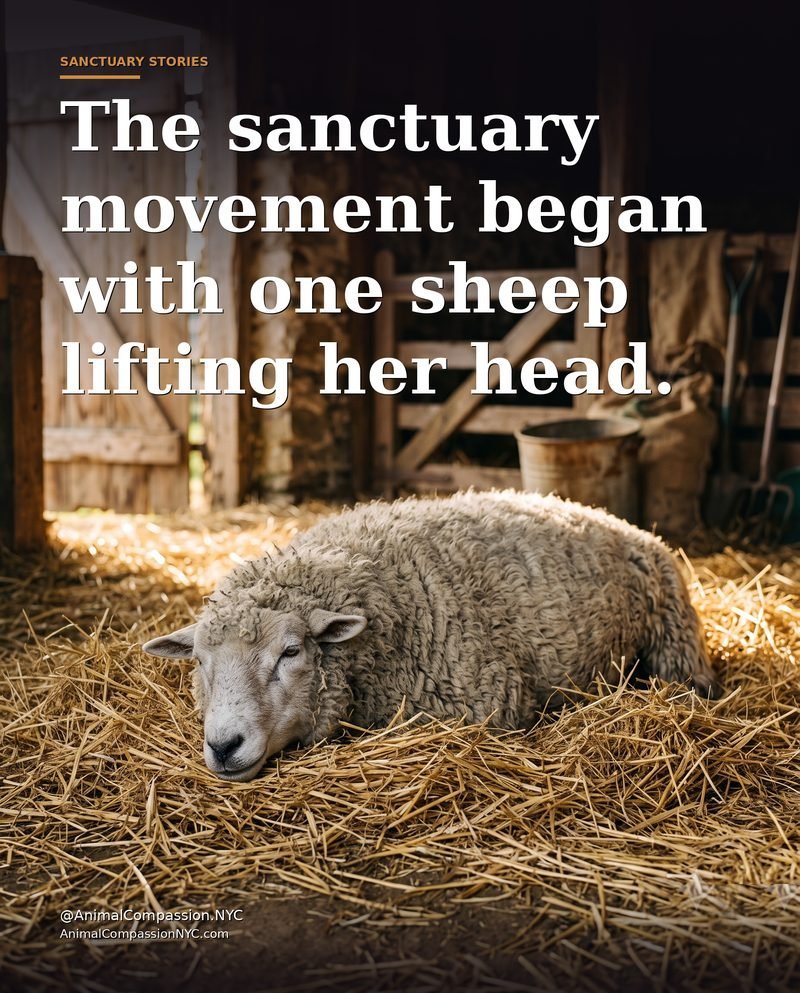
The American farm-sanctuary movement started on a stockyard dead pile.
In 1986, investigators walking Lancaster Stockyards in Pennsylvania found a sheep dumped among the carcasses, still breathing. They named her Hilda. Twenty minutes after a vet finally looked at her she was standing up and eating — she hadn't been sick at all, just collapsed from the transport. She lived eleven more years, and the organization that formed around her rescue, Farm Sanctuary, turns forty this year.
Nothing about Hilda changed that afternoon. What changed is that somebody looked at an animal the system had already filed under waste and saw a someone instead. That is the entire move. Psychologists call it moral expansion, and it almost never runs on new facts — it runs on refusing a category you were handed.
Watkins Glen now cares for more than four hundred residents across 275 acres upstate. Pigs, cattle, sheep, turkeys, chickens. Every one of them an animal who was supposed to be a number.
Go meet one. Visits, tours, and the resident biographies are all here:
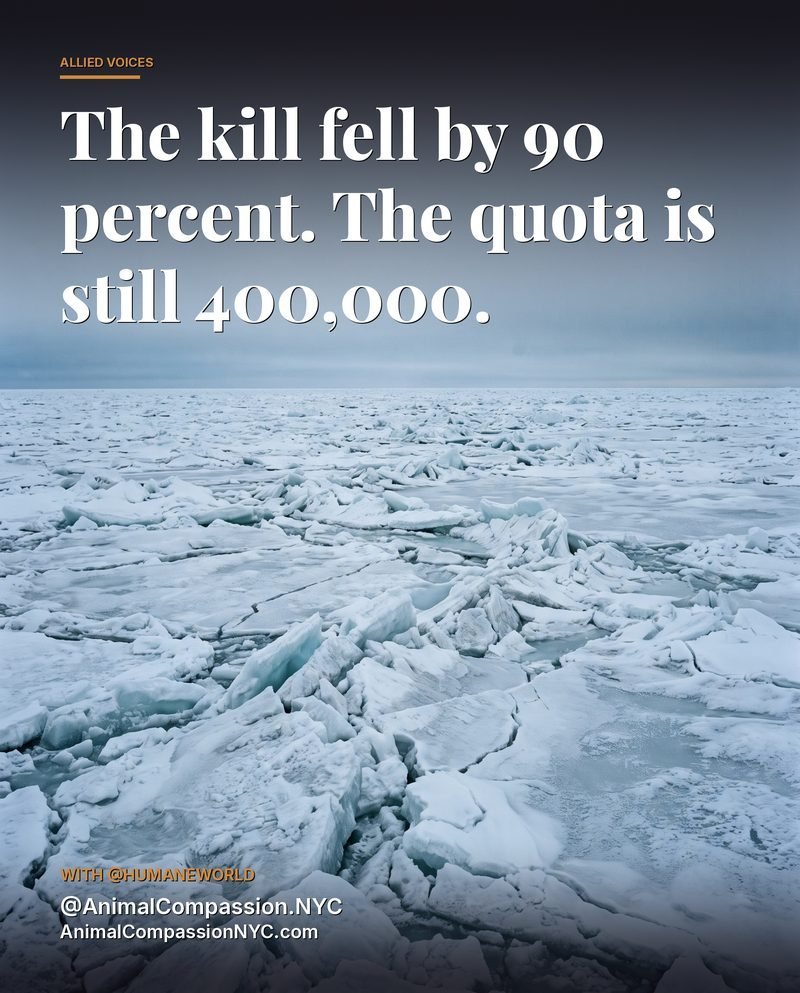
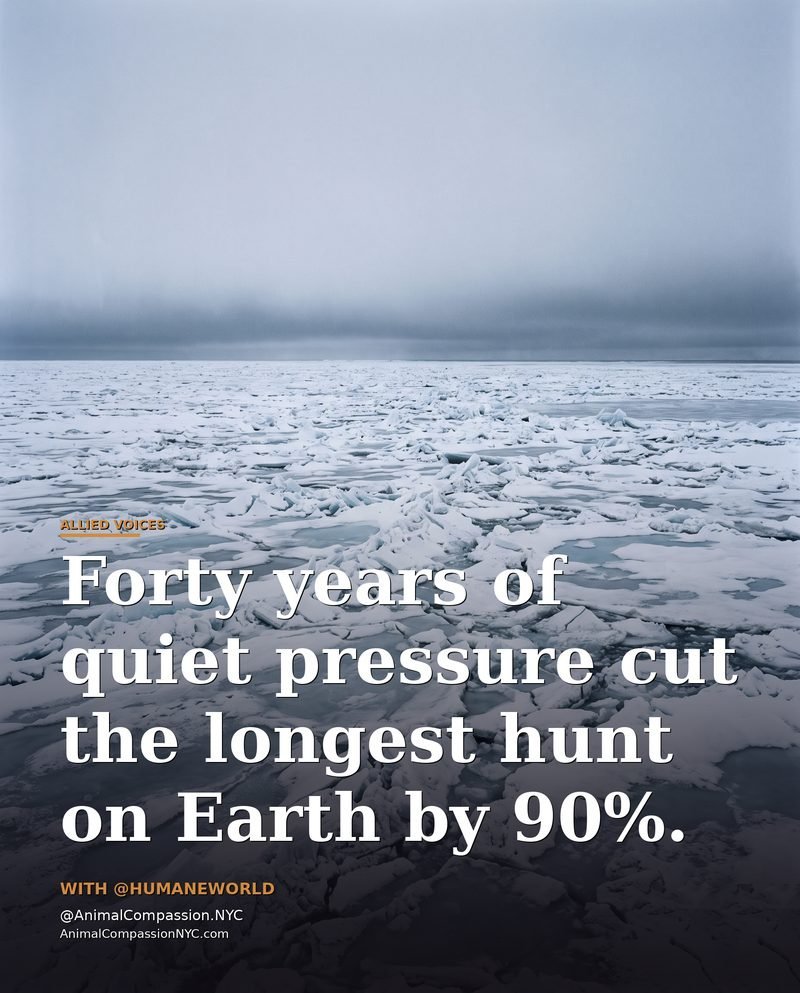
Humane World for Animals has been fighting Canada's commercial seal hunt for roughly fifty years. The kill is down about ninety percent. The quota has not moved.
Canada's East Coast hunt is the largest slaughter of marine mammals on earth, and for most of those fifty years the argument against it was simply losing. What changed was strategy. @humaneworld and its allies stopped trying to win the fight inside Canada and went after the markets instead. Thirty-five nations now ban trade in commercial seal products, and the kill fell from roughly 365,000 animals in 2004 to less than a tenth of that by 2022.
Here is the part worth sitting with. The harp seal quota is still set at 400,000. The boats, the licences, the infrastructure are all still there, waiting for demand to come back. A ninety percent reduction is not an ending. It is a campaign that worked and is not finished.
That is what real advocacy usually looks like. Not a viral moment. Fifty years of people refusing to accept that this is how it has always been done.
The image is ours; the work is theirs. Follow @humaneworld and read their seal campaign.
What is the fight you have decided not to let go of?
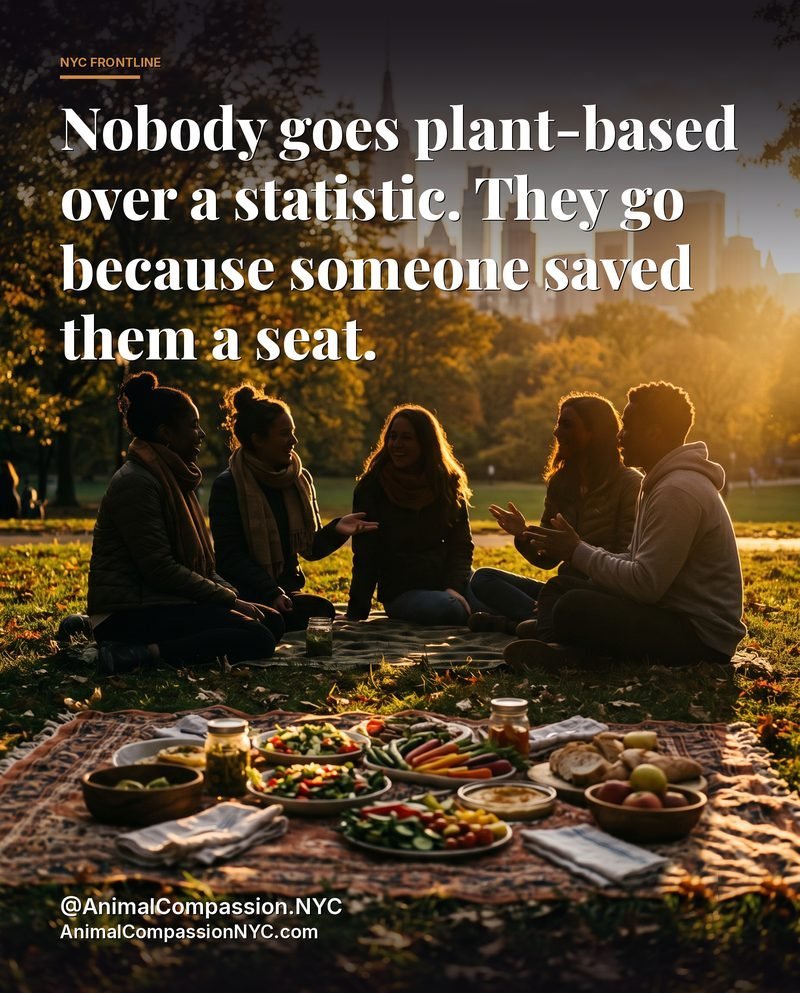
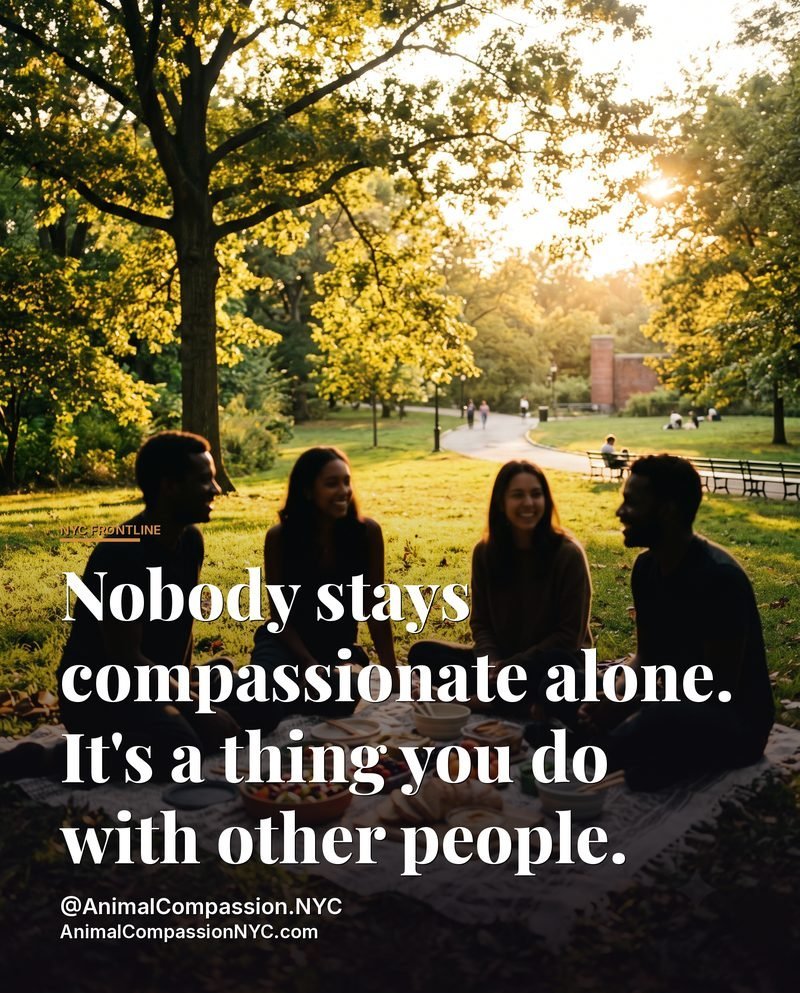
Nobody has ever changed what they eat because a stranger won an argument with them.
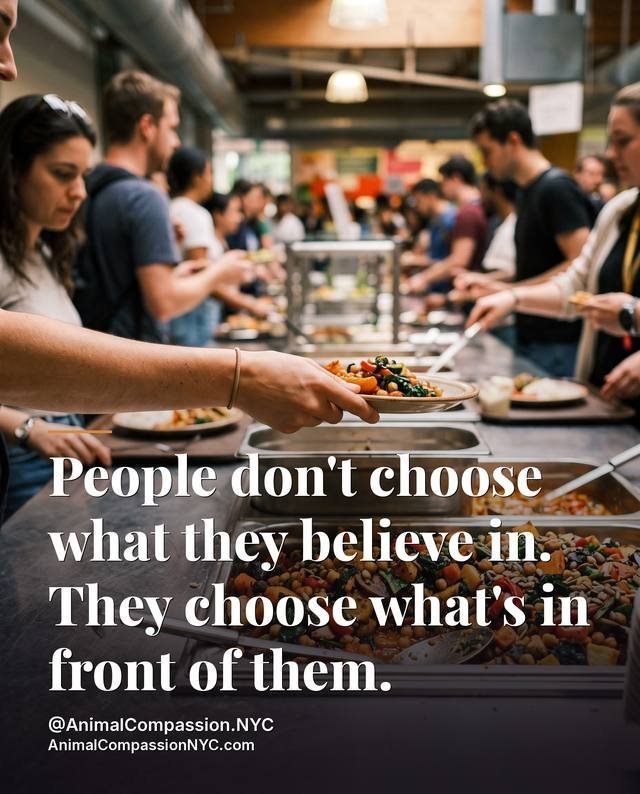
Think about the last time you actually changed your mind about something that mattered to you. It almost certainly wasn't a statistic. It was a person — someone you liked, doing the thing, making it look ordinary and easy and good. Psychology keeps finding the same shape: we take our read on what is normal and what is possible from the people we belong to. Identity moves first and information follows. That is why facts alone bounce off a defended belief, and why a plate handed to you in a park in August does not.
So make the food. Bring enough for someone who isn't vegan and has no plans to be. Don't quiz them, don't perform, don't wait for the conversation to turn your way. Save them a seat and let the meal do the talking.
Every person you have ever met who left animals off their plate for good had a first table where it felt easy instead of lonely. Be somebody's first table.
New York has the real thing if you want it — vegan meetups, Save vigils, restaurant crawls, sanctuary volunteer days. Isolation is the quiet threat to anyone who cares about this; the antidote is a calendar with other people's names on it.
Where did you find your people, or are you still looking? Tell us in the comments.
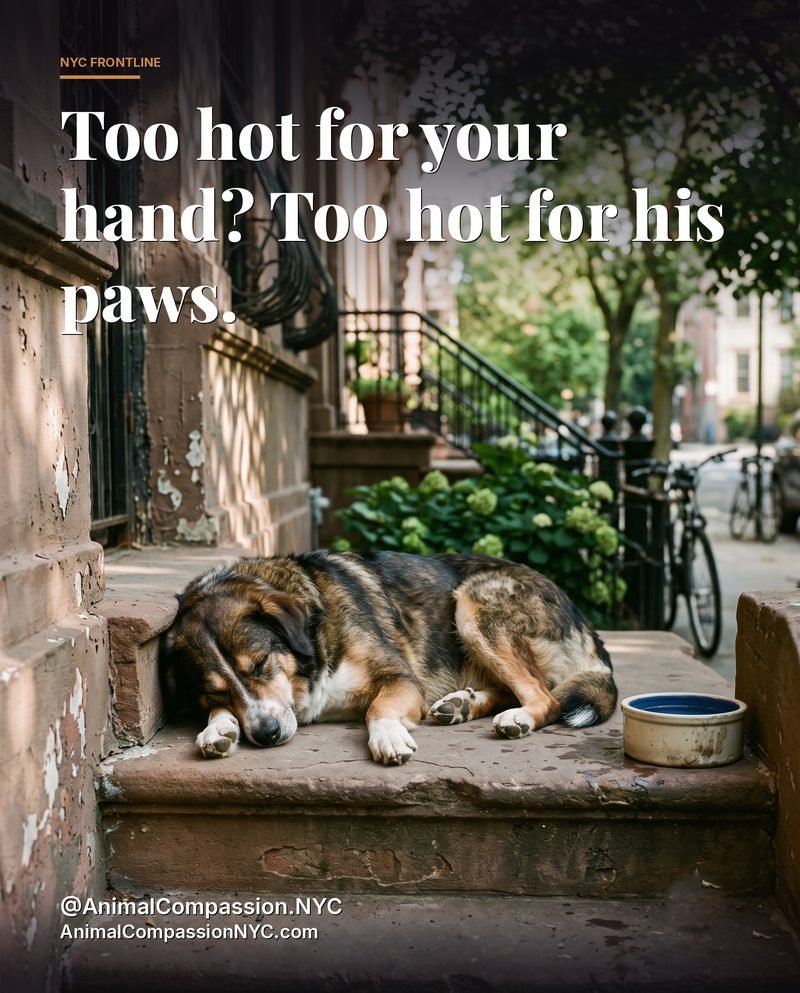
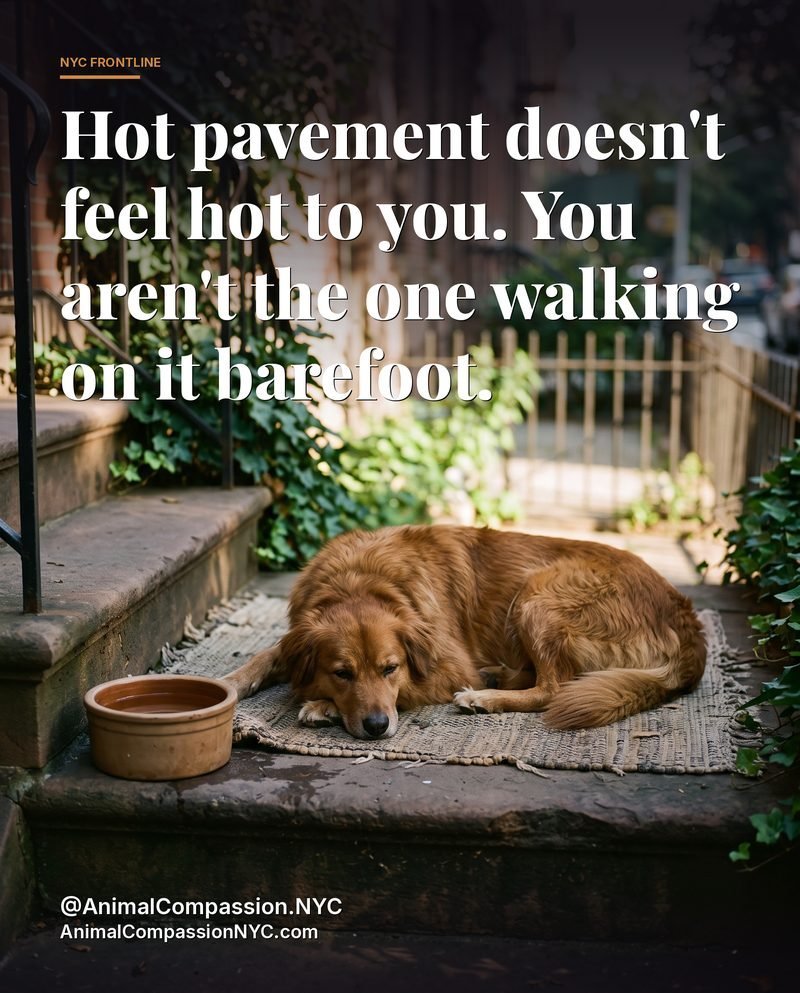
Put the back of your hand flat on the sidewalk and hold it there. Seven seconds.
If you pull away, so would he. He just doesn't get the choice. On a 77-degree day asphalt can climb past 125 — hot enough to blister skin in about a minute — and a dog crossing Atlantic Avenue at two in the afternoon is standing on it barefoot the whole way. He won't complain. He'll keep your pace because you set it, and we read that loyalty as consent when it is nothing of the kind.
The fixes are unglamorous and they work. Walk early and walk late. Take the shady side, take the grass. Carry water and offer it before he asks. And never leave him in a parked car — not for one errand, not with the windows cracked. The inside of a car in August sun becomes an oven faster than almost anyone guesses.
If you do see a dog shut in a car in this heat, call 911. In New York only an officer can legally open that door, so the call is the fastest help you can give. Don't talk yourself out of it.
Compassion isn't only the big argument about animals suffering somewhere far away. Most days it is the small check nobody sees you make.
Send this to the person you know who walks their dog at noon.
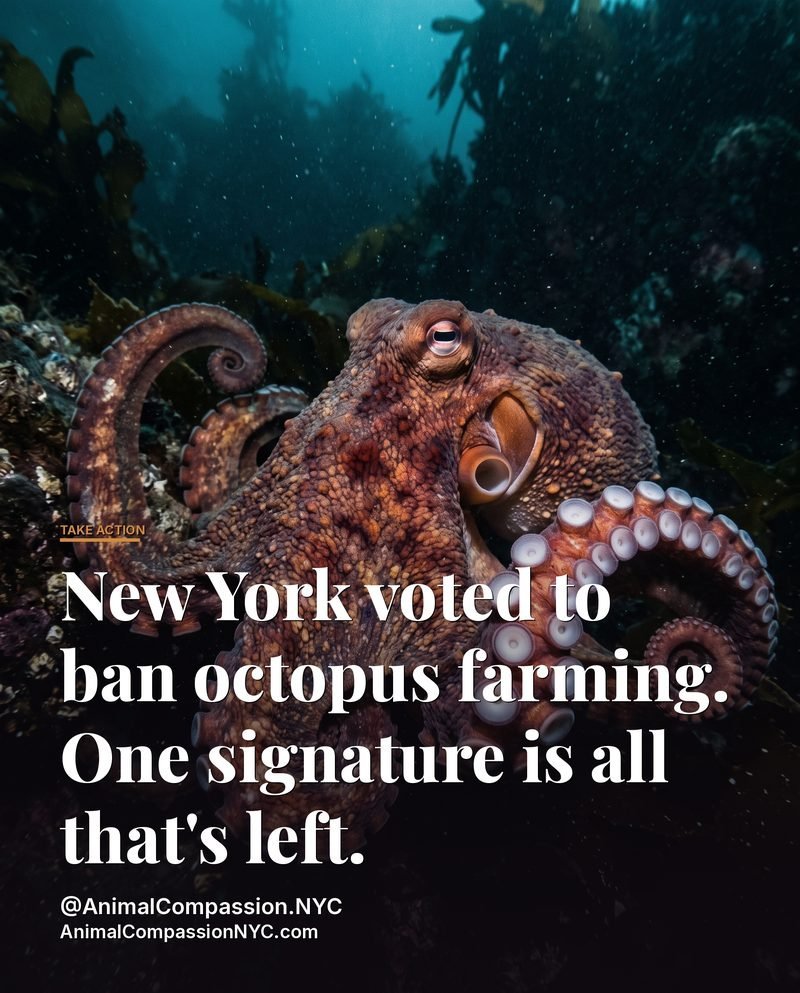
New York already voted to ban octopus farming. It just isn't law yet.
On June 4 both chambers passed S.7421-B, Sen. Monica Martinez's bill barring anyone from raising octopuses for food in this state. The Senate vote was 55 to 5 — animal bills almost never move like that.
It's a law written before the industry exists, which is exactly why it's easy to let slide. Nobody is being rescued today, so nothing feels urgent. That's the trap. Octopuses solve puzzles, recognize individual faces, and come apart in confinement — the humane moment to refuse to farm them is before the first tank goes in, not after. Spain's Nueva Pescanova withdrew its Gran Canaria farm application in July after a five-year fight; the industry is stoppable while it's still hypothetical.
The bill is sitting with Governor Hochul now, alongside several other animal-protection bills the legislature already passed. A signature is the only thing left between an octopus farm and a ban on one.
Two minutes. Ask her to sign it.
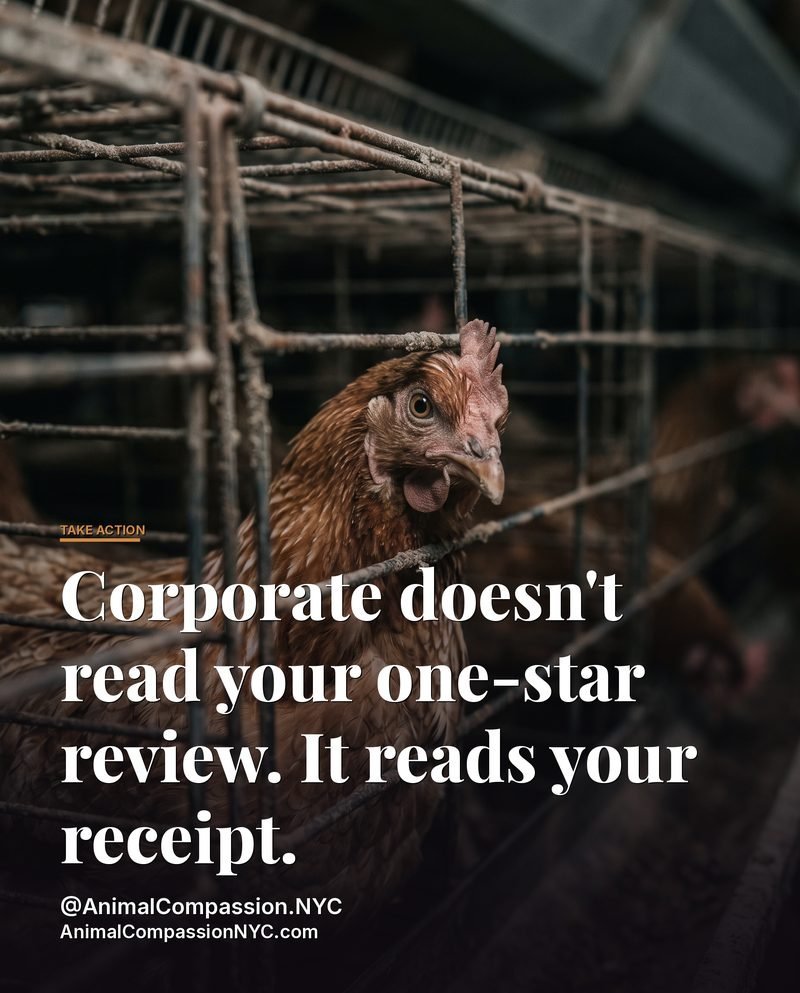
In 2018 Marriott promised to be 100% cage-free for hens by 2025. That deadline came and went.
Marriott's own 2026 reporting confirms millions of hens are still in cages; the company points at bird flu and supply chains. Animal Equality has been on it all year — megaphones in Canary Wharf in January, actions from New York to São Paulo.
Here's the part that's easy to miss: what moves a hotel chain isn't outrage online. It's the slow, boring kind of pressure attached to money and reputation. Corporate genuinely reads its own review pages, because those pages are revenue.
So leave one. Say you stayed, say you noticed the broken cage-free promise, and say it calmly — a measured review from a real guest is far harder to dismiss than a hundred angry comments. Compassion doesn't always look like rescue. Sometimes it looks like being politely, persistently inconvenient on behalf of a bird you'll never meet.
Sign the petition, and leave the review:
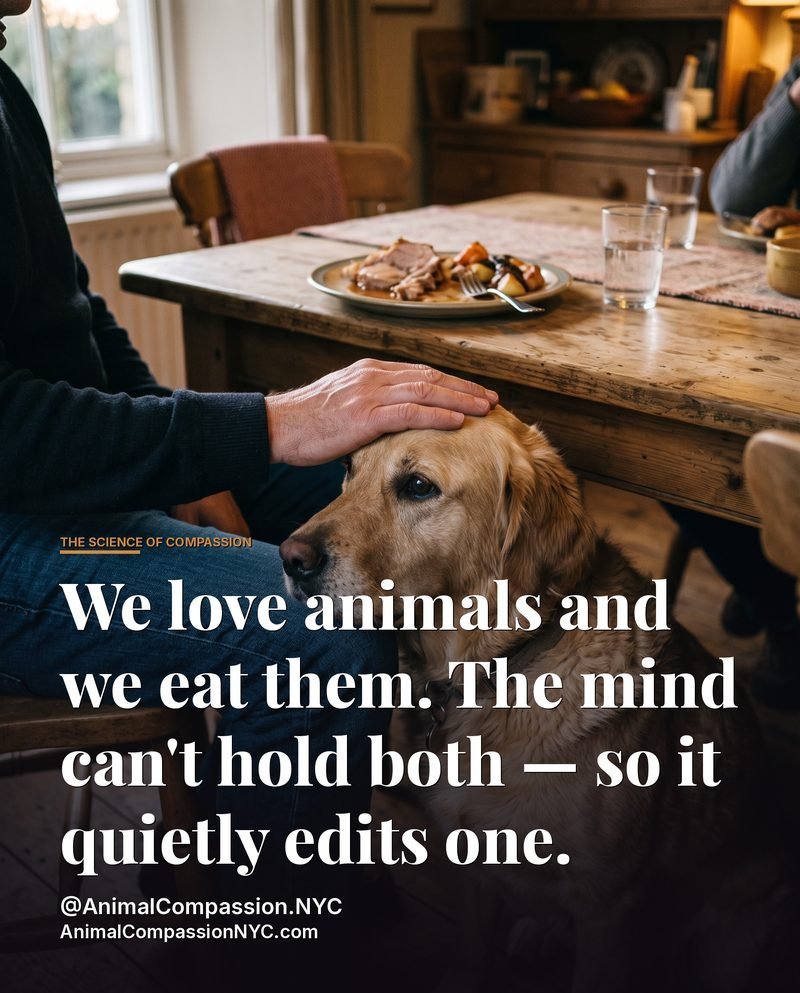
Psychologists call it the meat paradox: most of us care about animals and also eat them, and the mind can't hold both comfortably for long. So it adjusts. Loughnan, Haslam and Bastian (2010) found that people who had just eaten meat granted food animals less moral status and less of a mind than people who hadn't — the belief bends to fit the plate, not the other way around.
Notice what that means. The discomfort isn't a flaw in you, and it isn't hypocrisy. It's the caring part still there, still working, still arguing — which is exactly why the mind has to work so hard to talk it down.
Next time that flicker shows up, don't edit it. Let it finish its sentence.
Almost nobody is argued into caring about animals.
Ask someone who changed and they'll tell you about a moment, not a study — a dog who grieved, a pig who remembered them, a hen who wandered over to see what they were doing, a fish that held their gaze a beat too long. The facts came later, once they'd already decided the animal was a someone.
Moral circle expansion tends to move through encounter, not evidence. Which means the most useful thing most of us can do isn't win the debate at dinner. It's make an introduction.
Who taught you to see them differently? Tell me in the comments — I'll go first.
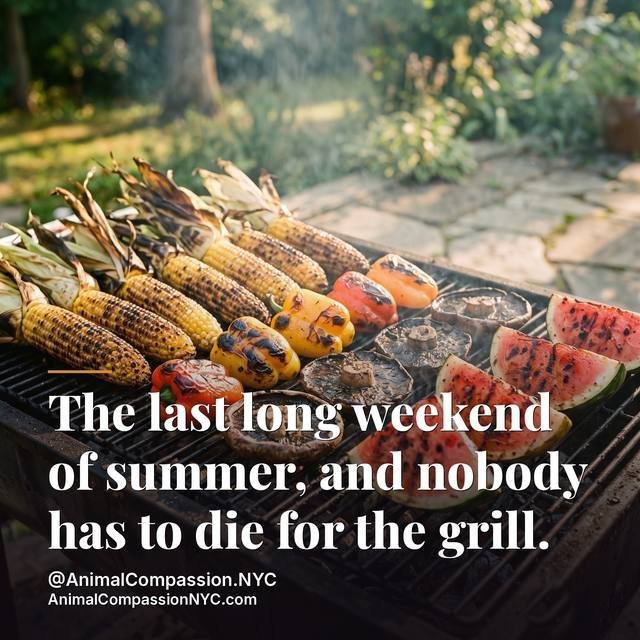
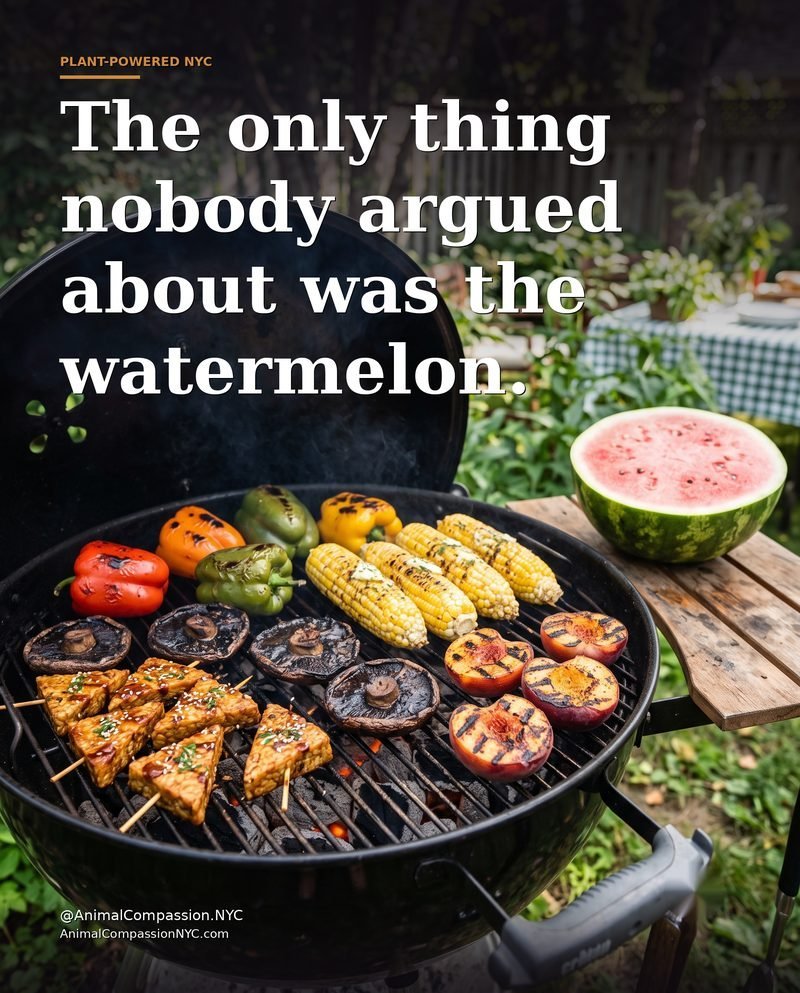
The only thing at the cookout nobody argued about was the watermelon.
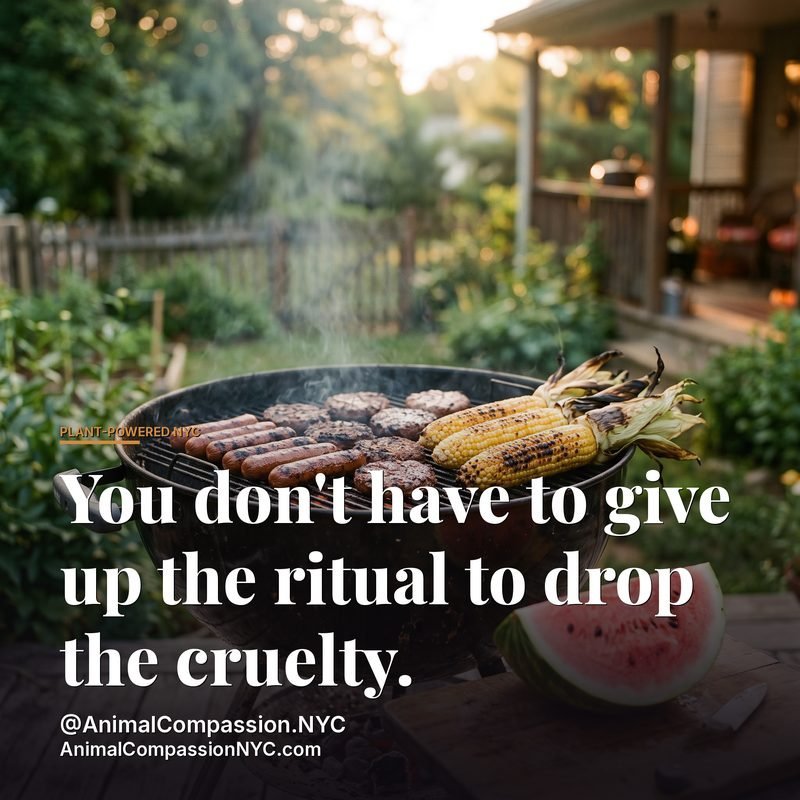
August is peak grill season, and a backyard in Brooklyn smells exactly the same whether or not an animal died for it. The dogs are tofu, the burgers are Impossible, the corn is dripping, the watermelon is doing what watermelon has always done — and not one person at the table demanded it justify itself.
That's the part worth noticing. The ritual was never the meat. It was the smoke, the folding table, the people standing around waiting for something to come off the grate. You don't have to give up the ritual to drop the cruelty. You just swap the center of the plate.
Tag your favorite plant-based hot dog — somebody's about to shop for one.
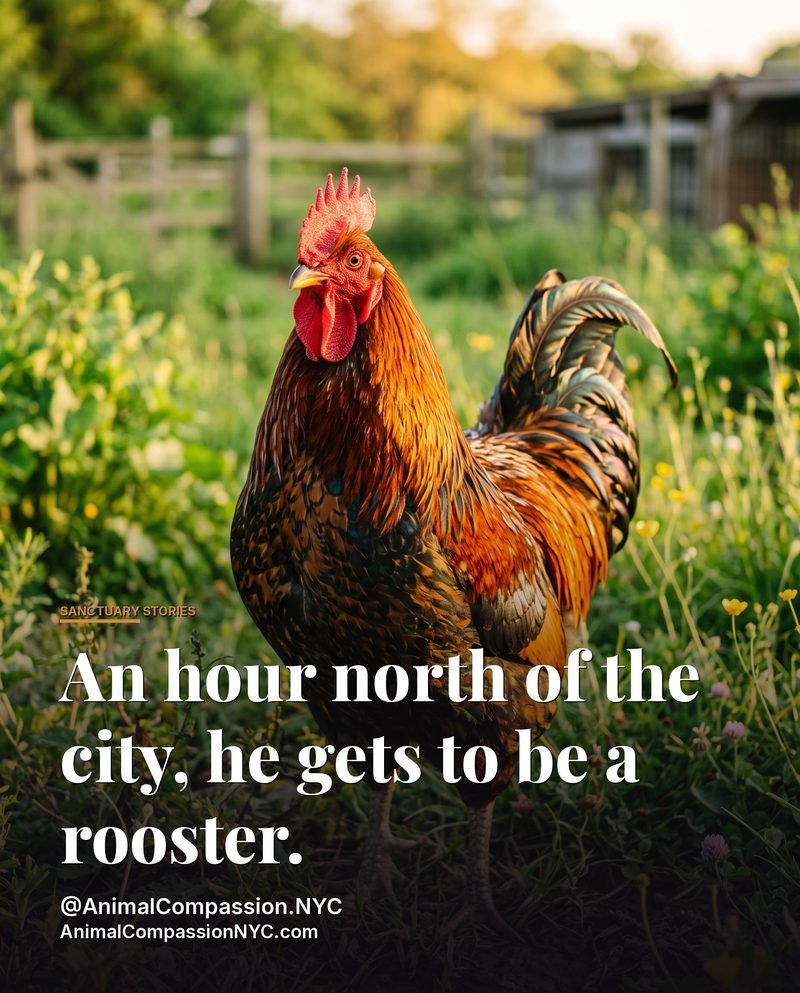
Safe Haven Farm Sanctuary in Poughquag, NY gives rescued farm animals what the system never offered: time. Roosters who were never meant to crow past six weeks, pigs bred to be slaughter-weight as babies — here they simply get to grow old. Closing out July: go meet one before the summer ends. The drive is short; the shift is permanent. Tours run weekends by appointment — call Bill or Ellen a day ahead at 845-724-5138.
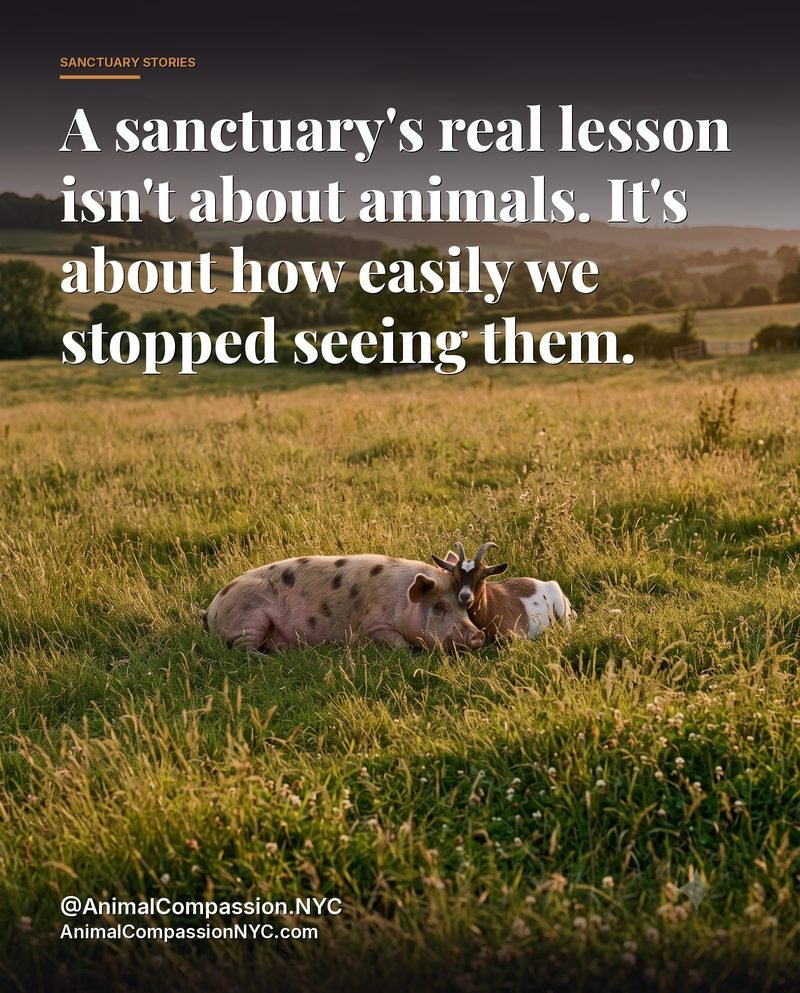
A whole month of Sanctuary Fridays comes down to one quiet lesson: the animals we're taught to see as products turn out, on contact, to be somebody. Sanctuaries don't argue that for you — they just remove everything in the way of you noticing it yourself. If you do one thing this summer, stand in a field with a rescued pig. The rest tends to follow.
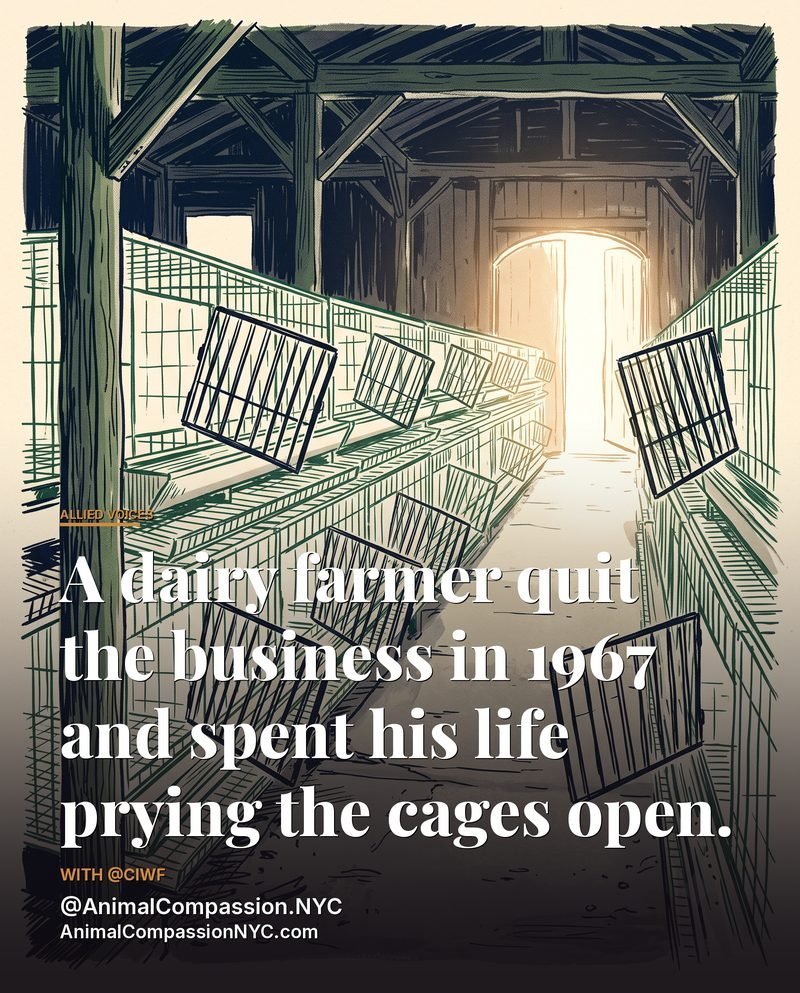
In 1967 a Hampshire dairy farmer named Peter Roberts walked away from his own herd. He had watched intensive farming arrive from America and could see exactly where it was going. He tried to get the existing welfare groups to take it seriously. They wouldn't. So he founded Compassion in World Farming and spent the rest of his life prying the cages open.
Nearly sixty years on, @ciwf is still doing the slow, unglamorous half of this movement — the policy fights, the corporate commitments, the country-wide bans on sow stalls and battery cages. That work never trends. It also moves more animals out of cages than anything else we have. Their End the Cage Age coalition is in Brussels right now, pressing the European Commission to finally deliver the legislation it promised.
Credit where it's due. Somebody has to play the long game, and they've been playing it since before most of us were born.
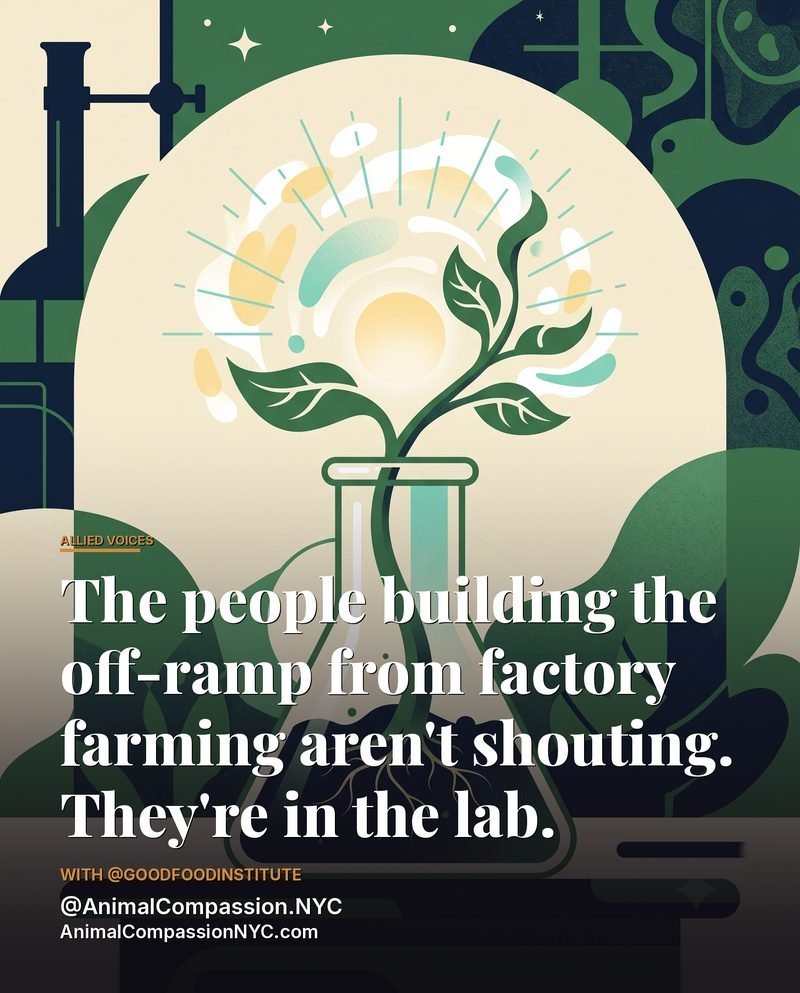
Not every animal advocate carries a sign. Some of them are food scientists.
@goodfoodinstitute works a bet that sounds unromantic and may turn out to be decisive: that factory farming ends fastest when the alternative is cheaper, better, and boring to choose. Their 2026 State of the Industry reports put global retail sales of plant-based meat, milk and cheese at about $28.9 billion for 2025 — up three percent — while investment in cultivated meat fell hard, to $73.9 million from $139 million the year before.
That is not a victory lap. It's an honest ledger, and honest ledgers are rarer in advocacy than they ought to be. Change that depends on everyone becoming a better person is fragile. Change built into the price of dinner is not.
Both things are true at once. We move hearts, and we move the shelf.
Seven seconds. Put the back of your hand flat on the sidewalk and hold it there — if you can't, neither can your dog, and he doesn't get a vote about where you walk him.
Late July in New York is a quiet emergency for the animals living closest to us. Asphalt runs far hotter than the air above it. A parked car turns into an oven in minutes, even with the windows cracked, even 'just for a minute.' Water bowls that were full at noon are dust by three.
None of this takes a march or a manifesto. It's the smallest, most domestic version of the thing we ask about farms and labs — notice who is suffering, then change what you do. Walk early, walk late, carry water, use the shade. If you see a dog shut in a car in distress, call 911; you are not overreacting.
Save this and send it to whoever you saw walking a dog at two in the afternoon.
Compassion isn't a personality trait. It's a calendar.
The people who stay in this work — for years, not months — almost never do it alone. They have a vigil they show up to, a potluck that expects them, a sanctuary van that leaves at seven. New York makes that unusually easy: vegan meetups in every borough, Animal Save vigils, restaurant crawls, volunteer days at sanctuaries an hour north.
Isolation is the quiet thing that ends most people's activism, long before burnout gets the blame. The fix is embarrassingly ordinary — other people's names, written down, next to a time.
Tell us in the comments where you found your people, or where you're still looking. Somebody reading this is in your borough.
The most powerful animal-welfare lever isn't persuasion — it's defaults. When institutions make plant-based the standard option (schools, hospitals, city events), participation soars without anyone being lectured. Ask your workplace, your kid's school, your co-op: what's the default here, and who decided? Changing one default outperforms a hundred arguments.
We treat plant-based food as second-class through a quiet emotion: disgust's cousin, contempt — 'rabbit food,' 'fake meat.' But disgust is famously trainable; it follows culture, not biology. The same reflex that once made oysters peasant food and lobster prison rations can be retrained on a generation's timescale. Taste is downstream of meaning.
Not the whole life overhaul. Just the next honest answer. Maybe it's one fewer animal on the plate this week, one conversation you stop avoiding, one sanctuary visit before the season turns. Compassion rarely asks for everything at once — it asks for the next true step. What's yours?
“Why do human egos seem so threatened by the thought that other animals think and feel?” Carl Safina asks it in *Beyond Words*, and the science keeps answering him: there is somebody in there. Sentience stopped being a fringe claim a long time ago — it’s the consensus we keep eating around. The discomfort was never about the evidence. It’s about what the evidence asks of us. Sit with that one this week.
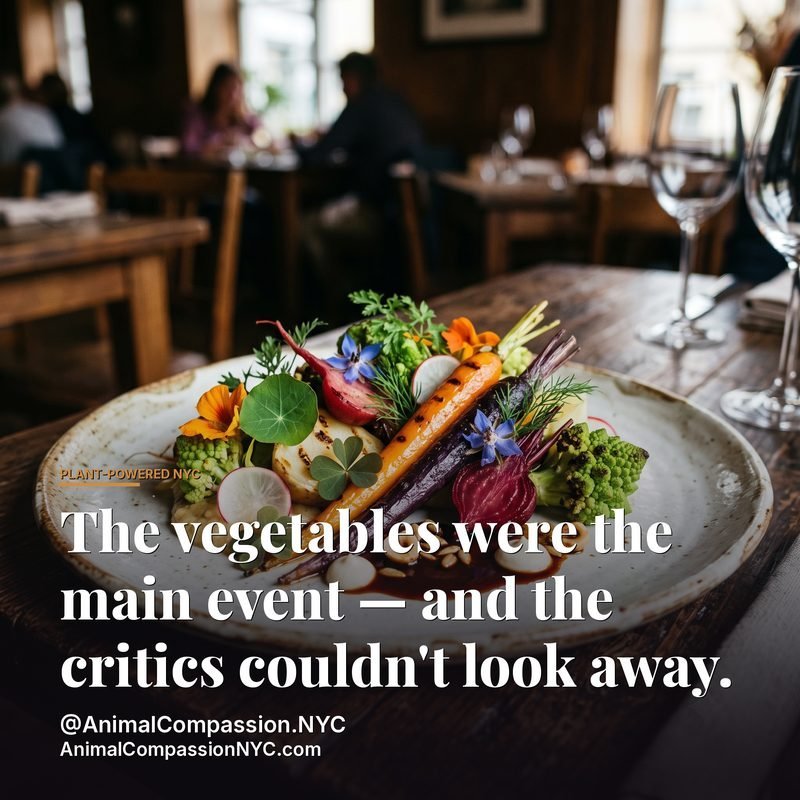
Amanda Cohen's Dirt Candy put vegetables at the center of fine dining in NYC before it was fashionable — no meat, no apology, just a tasting menu that treats a carrot like an event. It quietly demolished the idea that vegetable-forward cooking is a compromise. It was always the more interesting problem to solve.
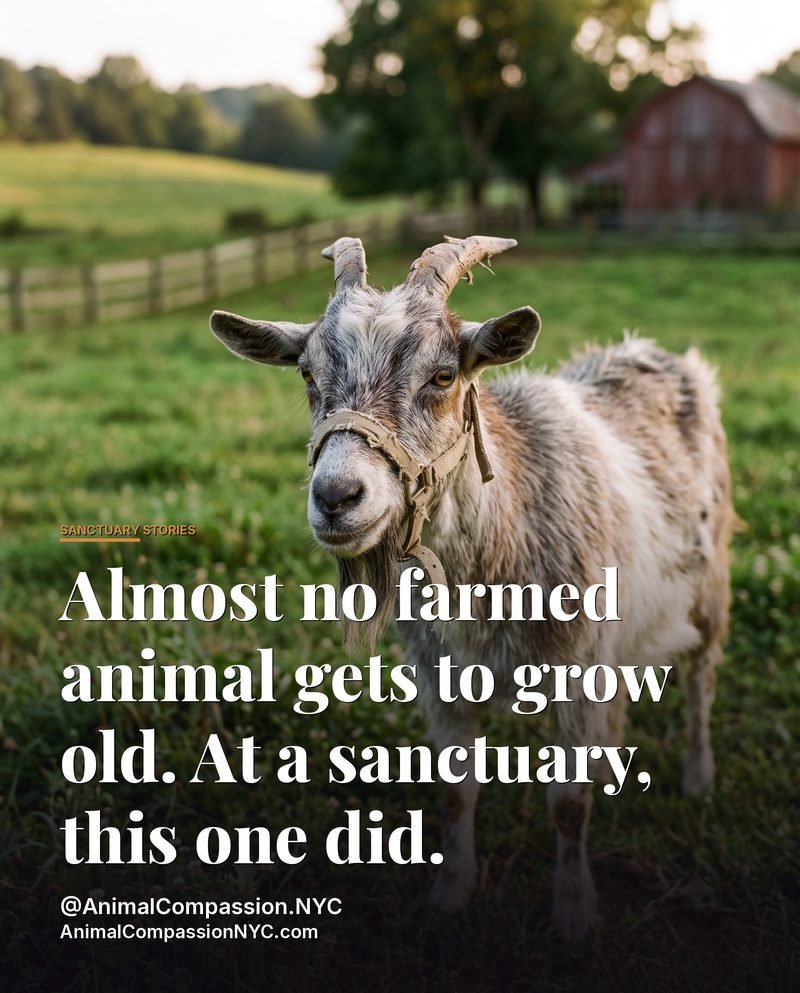
An old goat is a rare sight. In the food system, almost no farmed animal reaches old age — they're gone long before their bodies would ever slow down. So a gray muzzle, worn-down horns, an easy unhurried gait: most people never get to see them. At Indraloka Animal Sanctuary in northeastern Pennsylvania, nearly 300 rescued farm animals get exactly that — a lifelong home, and the ordinary dignity of growing old. Being weathered isn't a defect here. It's the whole point: proof that a life was allowed to run its full length. Follow a sanctuary. Visit one if you can. Watch an animal grow old in front of you, and notice how fast 'livestock' stops being the right word.
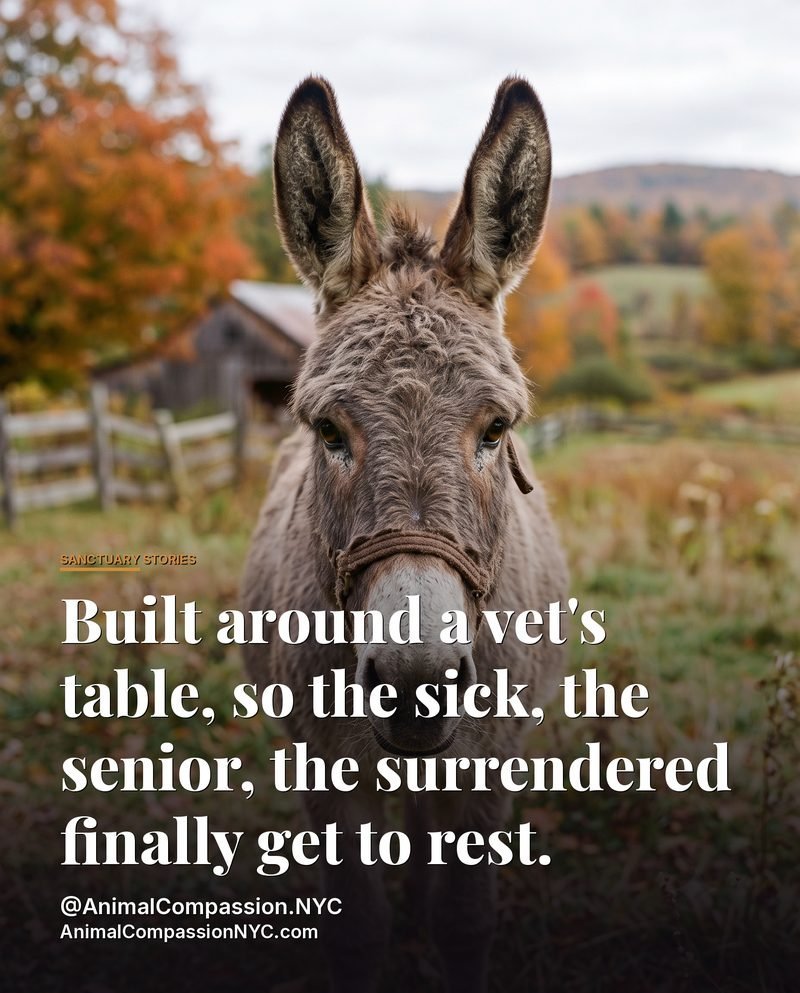
Most farms are built around production. This one is built around a vet's table. Unity Farm Sanctuary in Sherborn, Massachusetts exists for the animals nobody else will take — the ill, the disabled, the senior, the surrendered. Its whole model is care: lifelong medical treatment for creatures the industry writes off as a loss the moment they stop turning a profit. A donkey like this isn't an asset being managed. He's a patient being kept comfortable, a neighbor being kept company, for as long as he lives. 'Rescue' isn't one dramatic moment — it's mostly years of unglamorous, expensive, daily tenderness. When you picture a farmed animal, picture this face. Then choose the plate that lets more of them reach it.
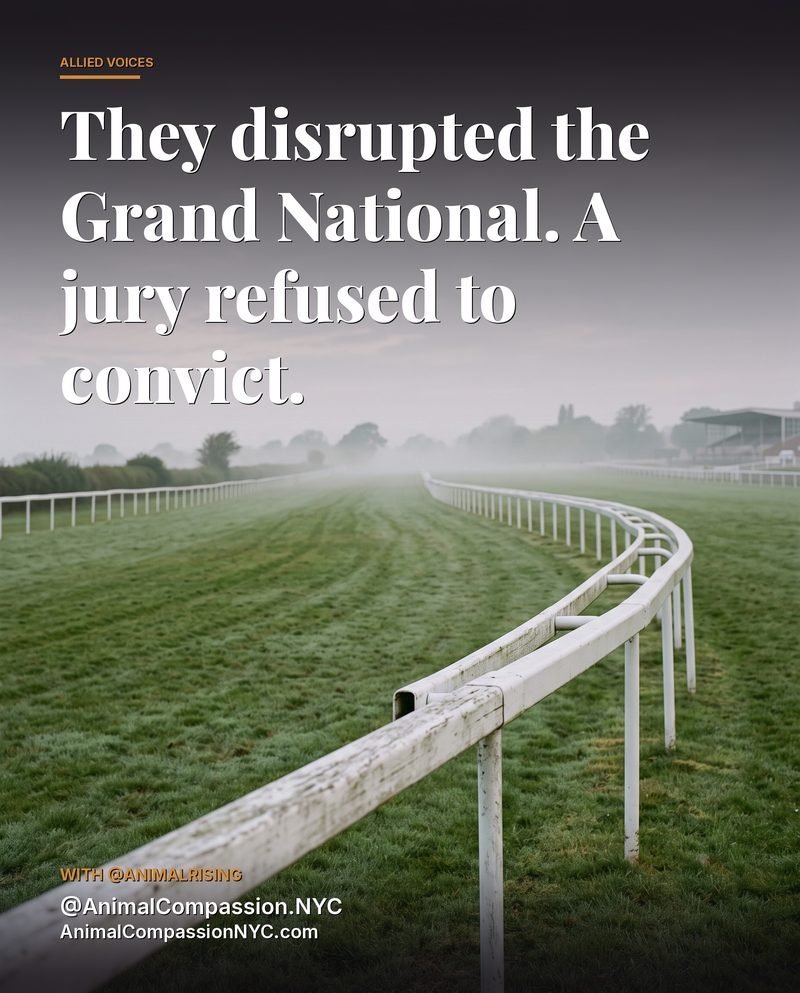
In 2023, @animalrising activists walked onto the track and stopped the Grand National — Britain's biggest race — because horses keep dying at it. They were charged with public nuisance. A jury heard them out and refused to convict.
That verdict travels. It reframes disruption as what it often is: not a tantrum, but a considered moral argument made because the usual channels have failed the animals in question. There's a long American tradition of exactly this kind of action — one the animal movement is still relearning.
Disruption isn't the opposite of seriousness. Sometimes it's the proof of it.
Credit to @animalrising for making the case — in court and out of it.
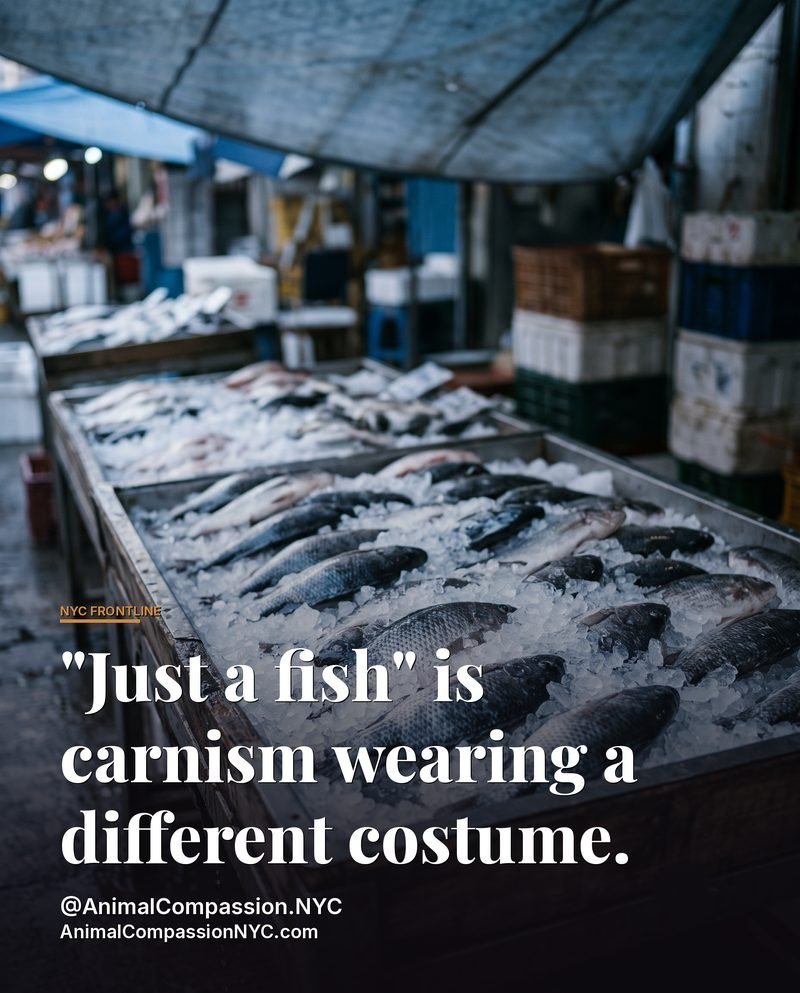
Fish are the animals our empathy reaches last.
New York moves staggering volumes of seafood through markets like this one, and almost none of it registers as a welfare question. Fish are cold, silent, and uncannily other — they don't scream, and we can't read their faces. So the mind quietly files them under seafood instead of animals.
The science has gotten harder to wave away. Fish have nociceptors. They learn, they remember, they trade pain off against reward the way mammals do. "Just a fish" was never a finding. It's a permission slip.
That's carnism doing what it always does — sorting sentient beings into the edible and the unthinkable, then handing us a reason not to look.
Look anyway. Then pick one meal this week that doesn't need the ice.
California's Prop 12 set minimum space standards for farm animals — enough room for a mother pig to stand up and turn around, and little more. The pork lobby's answer, the so-called Save Our Bacon Act, would gut it nationwide, and its language already passed the House inside this spring's farm bill. The Senate left it out of its draft last month — for now. Floor amendments are exactly where provisions like this sneak back in.
Voters passed Prop 12. The Supreme Court upheld it. The only way to lose it now is quietly — which makes this the week your senators need to hear from you.
One call protects every state-level farm-animal welfare law in the country. The other side is counting on you not making it.
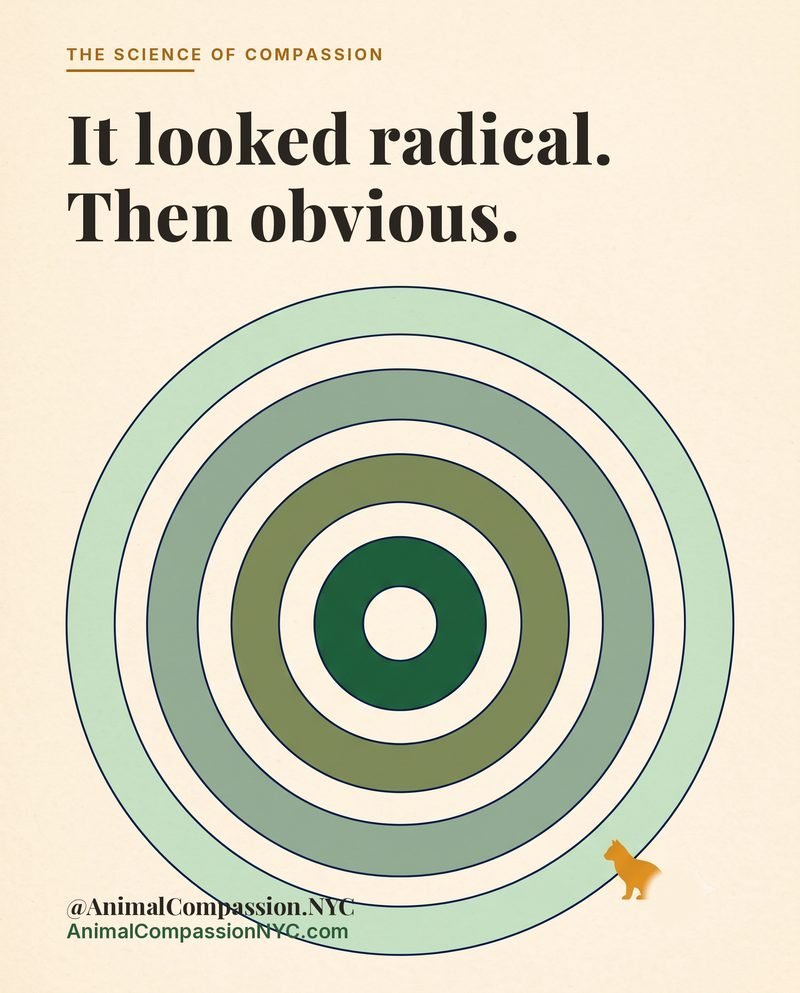
Peter Singer borrowed a phrase — the expanding circle — for the long arc by which humans extend moral concern outward: from the tribe, to the nation, to other races, to other sexes, and now, haltingly, to other species. Each expansion looked radical right up until it looked obvious. Animals are simply the current edge of a very old line.
"The animals of the world exist for their own reasons. They were not made for humans any more than black people were made for white, or women created for men." — Alice Walker.
The whole moral revolution fits inside that one sentence. Every justification for using them quietly assumes they were put here for us — as property, as dinner, as means to our ends. Walker doesn't argue the terms; she denies the premise. They are not ours. They are theirs.
Sit with that today. If it reframes something for you, pass it on — someone on your feed is one sentence away from seeing it too.
Modern Love — Isa Chandra Moskowitz's Brooklyn spot — does 'swanky vegan comfort food': mac and cheese, fried artichokes, the works, all plant-based. It's a reminder that going vegan in this city isn't an ascetic project. Sometimes it's just dinner that happens to leave everyone out of it who didn't want to be on the plate.
The animals who made the news running loose through New Jersey didn't get lucky. Someone decided they mattered.
Skylands Animal Sanctuary & Rescue in Wantage, NJ is where those stories end well. Founder Mike Stura built it around the ones who bolted — off trucks, out of yards, down the highway. Brianna, a Holstein, leapt from a moving slaughter truck onto Route 80 nine months pregnant. Two days later she gave birth to a calf named Winter — in a barn, not a kill line. That calf grew up in a pasture.
Every animal there ran toward the same thing: room, safety, a life that was theirs. The only difference between the ones who make it and the ones who don't is whether a person decides their run for freedom meant something.
Follow @skylands_sanctuary — and the next time an animal makes a break for it on the evening news, root for the ending where they win.
The loudest animal advocacy gets the footage. The most durable kind gets a syllabus.
New Roots Institute (@newrootsinstitute) — formerly the Factory Farming Awareness Coalition — doesn't chase virality. Its people walk into high school and college classrooms and teach students how the food system actually works: where what's on the tray comes from, who pays for it, and what a person can do about it. No shock reels, no shouting — just the slow, methodical work of changing who's in the room ten years from now.
Movements don't turn only on protests and petitions. They turn on the eighteen-year-old who hears the whole story for the first time and never quite unhears it. That's the quiet front, and it's where a lot of tomorrow's compassion is being planted today.
Credit where it's due: @newrootsinstitute has spent more than a decade doing the unglamorous classroom work most of us never see. Give them a follow — and if you teach, or know someone who does, see whether their lessons belong in a classroom near you.
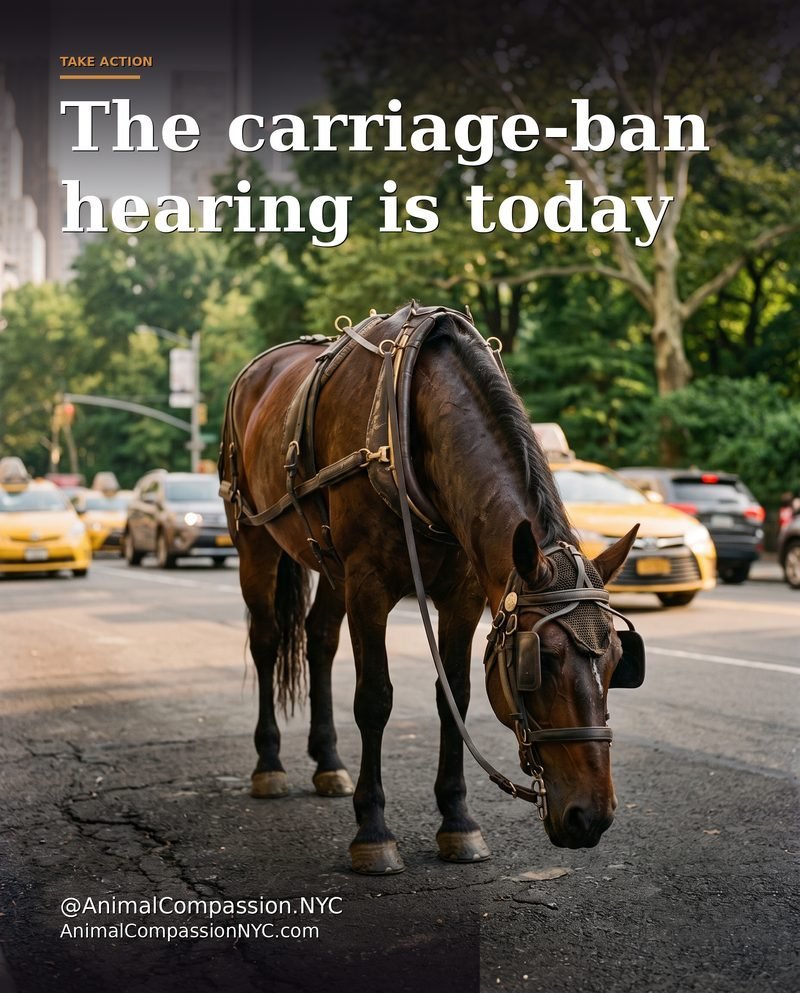
Right now, the horses have their hearing.
This morning the City Council's health committee takes up Intro 943 — Romanch's Law — the bill to phase out New York's horse-drawn carriage trade by 2028. It carries two names, Ryder's and Romanch's: a horse who collapsed in the street in 2022, and the 18-year-old killed last month when a carriage horse bolted in Central Park. One bill, two deaths, and that pairing is the whole argument. For the first time, sponsors hold a majority of the committee — five of its nine members — further than this bill has ever gotten, and a hearing is where momentum either becomes law or stalls for another year.
You don't have to be at City Hall to be counted. Friends of Animals (@friendsofanimals) rallies on the City Hall steps at 9 AM; the hearing follows at 10. Can't make it? You can still submit written testimony or sign up to speak by Zoom today. Compassion for these horses has a deadline, and it's this morning.
New York can be the next state to ban wild cats, bears, and primates in traveling circuses — animals hauled in trucks and trained through deprivation for a few minutes under the lights. Bills A.5850 / S.3629-A would end it. Albany's contact form is in our Act Now page; it takes two minutes.
When people defend eating meat, their reasons collapse into four buckets with striking reliability: it's natural, it's normal, it's necessary, it's nice. Piazza and colleagues called them the 4 Ns (2015). Naming them isn't a gotcha — it's a mirror. Once you can see the script, you get to decide whether you still believe it. Piazza et al. (2015), *Appetite*.
It's July, it's brutal, and nobody should have to choose between cooling off and their values.
The city is thick with plant-based scoops now — oat-milk soft serve, coconut gelato, cashew-cream pints that quietly end the 'but I could never give up dairy' conversation in one bite. And here's what that phrase hides: 'give up' treats dairy as ours to keep, when the milk was never meant for us — it's meant for a calf who was taken so we could have the carton. A plant-based scoop skips all of that, and still tastes exactly like a New York summer.
So: no sacrifice, no cow-and-calf math, no compromise. Just a good cone on a hot block.
Drop your favorite NYC vegan ice cream spot below — somebody scrolling past needs the rec.
"The least I can do is speak out for those who cannot speak for themselves." — Jane Goodall. She spent a lifetime proving that the line between us and them was always thinner than we were taught. The voice she's talking about isn't loud; it's just steady, and it's available to all of us.
You can't argue anyone into caring about a turkey. You can only introduce them to one.
Catskill Animal Sanctuary in Saugerties sits about ninety minutes north of the city, home to hundreds of rescued farm animals. Ask a visitor what they remember and it's never a statistic — it's the moment a turkey leaned into them, or a horse chose their company over the open field. Empathy isn't taught at a sanctuary; it's just no longer obstructed. Meet one animal whose life was spared and the abstraction "farm animal" quietly comes apart in your hands.
They run guided weekend tours right through late November — you book ahead and go. Bring the friend who isn't sure yet.
Mercy For Animals built its reputation on undercover investigations that turned 'nobody knew' into 'everybody saw.' But the part that matters is what comes after the footage: corporate policy change, legal referrals, and a steady drumbeat of pressure. Witnessing is step one; they're built for step two.
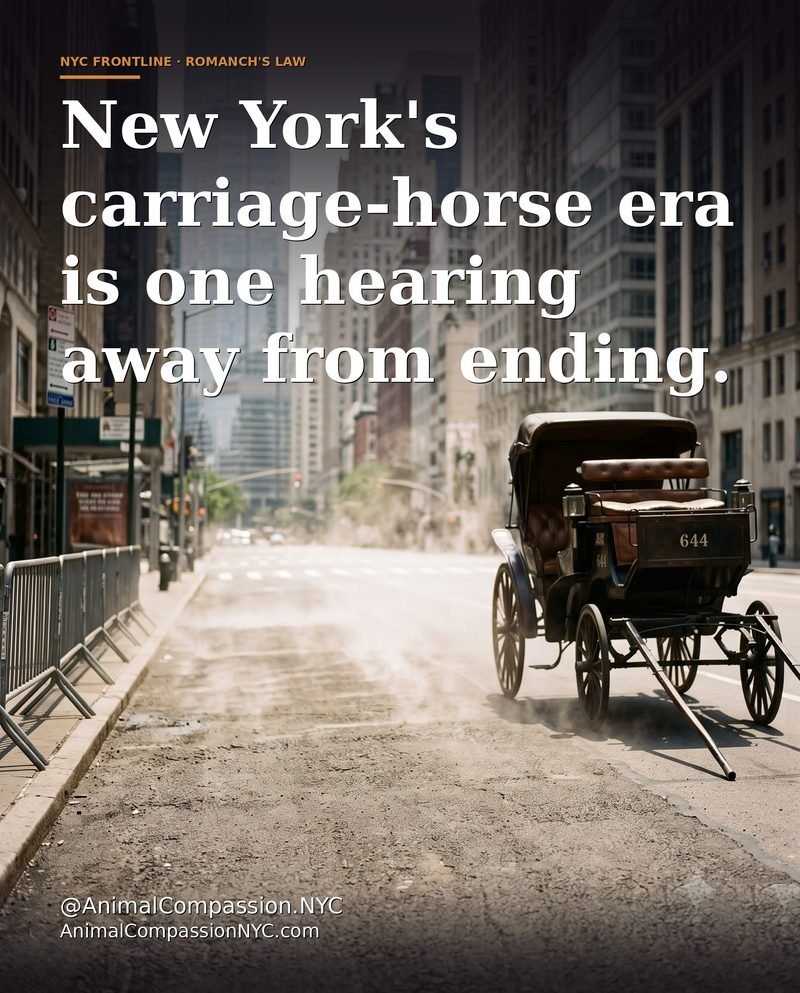
New York's carriage-horse era is suddenly one hearing away from its end. Last month an 18-year-old tourist, Romanch Mahajan, was killed when the carriage he was riding in flipped in Central Park. This week Council Majority Leader Shaun Abreu joined the push to pass Intro 943 — Romanch's Law — which would retire the industry by June 2028, and Speaker Julie Menin set a hearing: Wednesday, July 15, City Hall, rally at 9 AM.
And while the Council deliberates, July does what July does. The law already suspends carriage work at 90 degrees — or at 80 once the equine heat index hits 150. That a rule like that has to exist tells you what this job asks of a horse.
If you're in New York next Wednesday, show up. If you're not, add your voice.
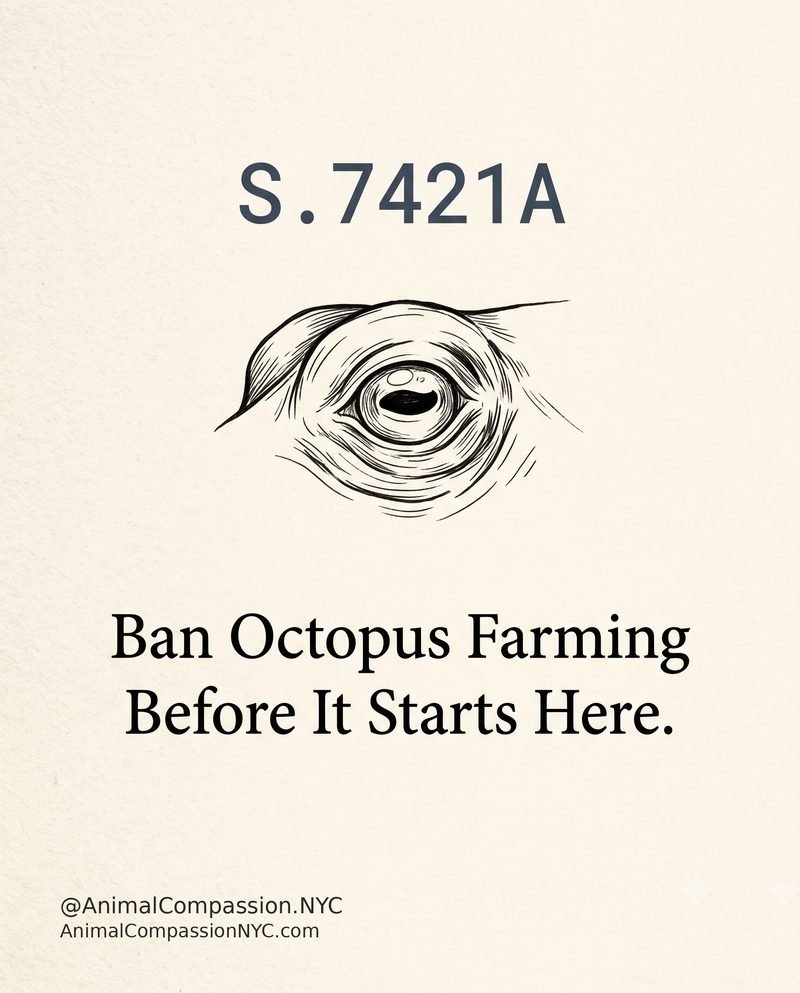
New York has a chance to outlaw octopus farming before the first tank is ever built. Octopuses are problem-solvers with personalities; farming them at scale would be a cruelty we can simply decline to invent. Bill S.7421A, sponsored by Sen. Monica Martinez. Two minutes to contact your legislator — link in the action page.
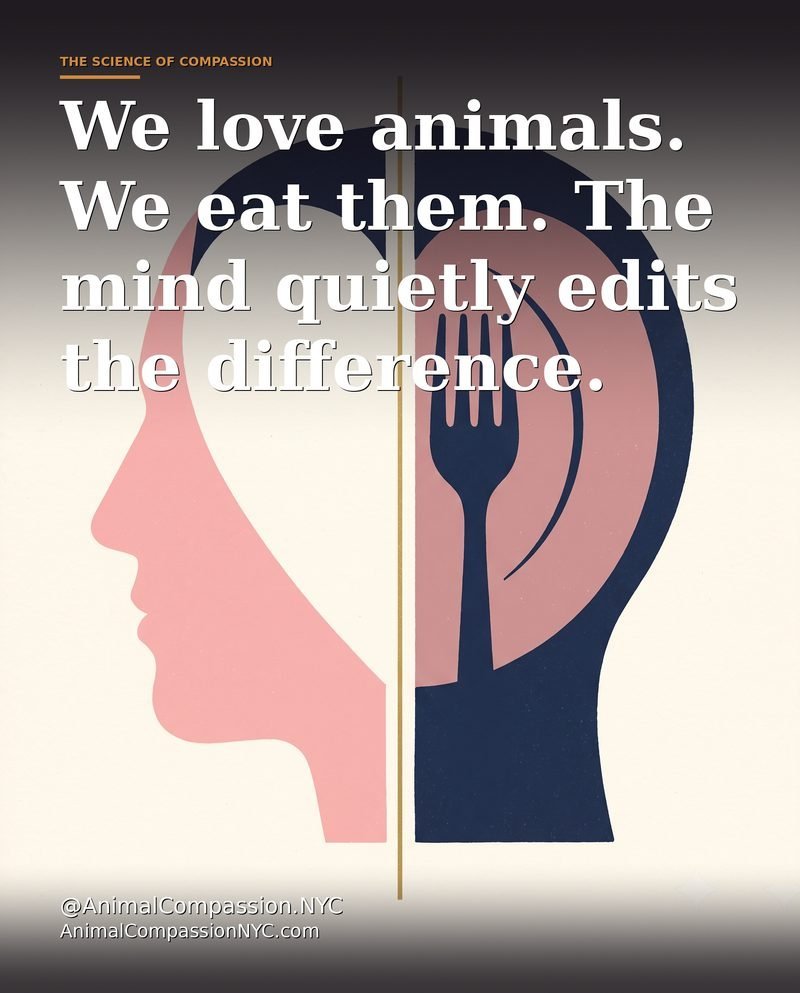
Psychologists call it the meat paradox: most of us care about animals and also eat them, and the mind cannot hold both comfortably for long. So it adjusts — we deny that food animals can suffer, or downgrade their minds, precisely when we're about to eat them. The discomfort is real, and it's the opening. Loughnan, Haslam & Bastian (2010) measured it.
We closed June on the question of where to begin. So here's July's: what's one thing you're going to do differently — not forever, just next? A meal, a call to a rep, a follow, a conversation you've been avoiding. Small is fine. Small is how it always actually starts.
Everything that makes a cookout taste like summer — char, smoke, fat, salt — is technique, not species. Thick-cut portobellos, marinated tempeh, whole charred peppers, grilled peaches for dessert. Save this for the next time someone says there's 'nothing to grill.' Drop your go-to in the comments.
Woodstock Farm Sanctuary in the Hudson Valley takes in animals the food system was finished with and lets them simply get old. Their residents have names, biographies, and grudges. Spend one afternoon there and the abstract argument about 'livestock' quietly dissolves into individuals you've met.
The Canadian commercial seal hunt is the longest-running organized slaughter of marine mammals on earth, and Humane World for Animals (formerly the Humane Society International) has tracked it for forty years. Public pressure cut the kill numbers by roughly 90% from their peak. That is what patient, evidence-backed advocacy looks like — slow, then sudden.
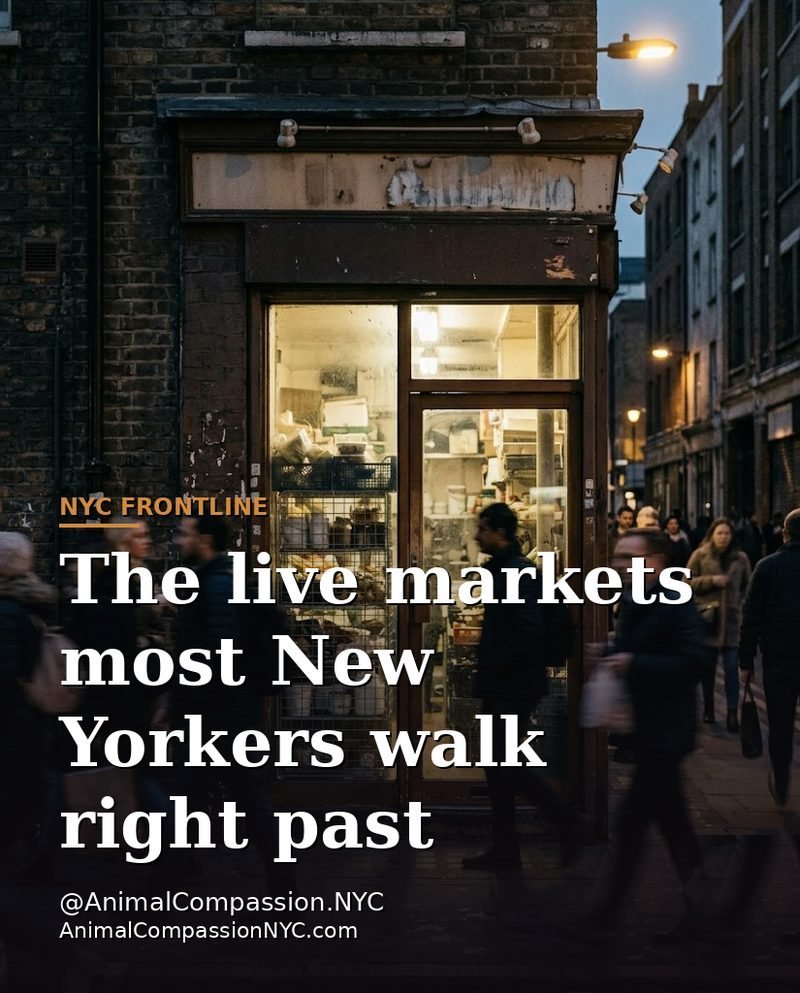
There are still scores of live-animal markets operating across the five boroughs — chickens, ducks, rabbits, goats, killed to order behind a storefront you've passed a hundred times. Familiarity is its own kind of blindfold; carnism keeps the slaughter in plain sight and out of mind. This summer, just notice one. Noticing is where it starts.
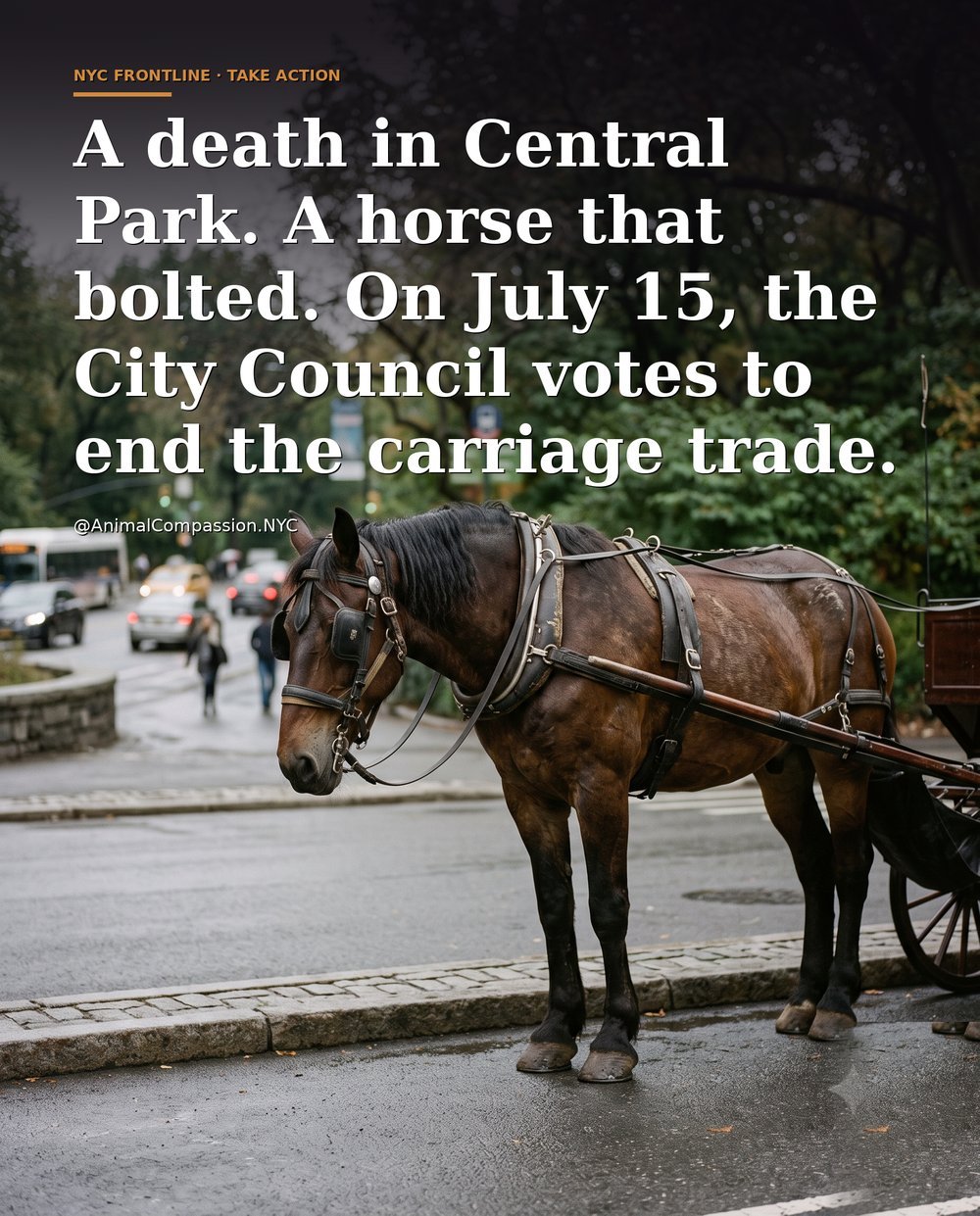
A horse spooked on a Central Park street, and an 18-year-old visitor never made it home.
For years the carriage trade has been argued as a horse-welfare problem — flight animals asked to stand on hot asphalt and thread midtown traffic, blinders on, until one of them bolts. On June 17 that danger took a human name. Romanch Mahajan, here on vacation from India, was killed when the horse pulling his cab panicked and flipped it. Rides were suspended, the drivers held a "safety stand-down," and then the horses went back between the shafts.
Compassion here isn't soft. A frightened prey animal in city traffic is a danger to itself and to everyone near it — you can mourn a young man and want the horses off these streets in the same breath. Those two things were never opposed.
On July 15 the City Council takes up the bill to end the trade — now being renamed Romanch's Law — which would also retrain the drivers for other work. If you're in NYC, that hearing is the moment to be heard. Tell your council member where you stand.
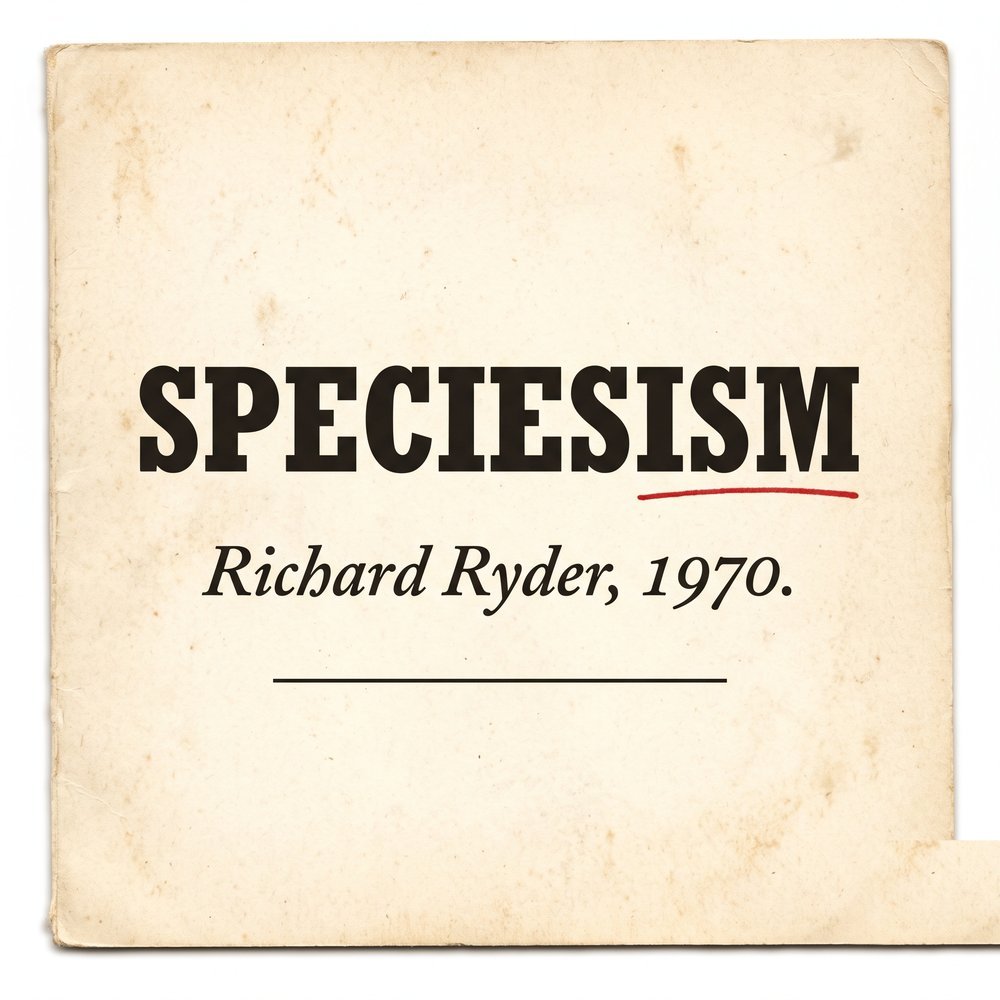
Speciesism started as a diagnosis, not a slogan.
Richard Ryder coined the word in 1970 to name a specific moral error: granting or denying moral consideration on the basis of species membership alone — the same logical shape as racism or sexism, just with the boundary drawn at the species line. Peter Singer carried it into the mainstream in 1975 with Animal Liberation.
Half a century on, the inconvenient part is how well it has aged. The science of animal cognition keeps closing the gap the philosophy pointed at — pigs that outperform dogs on some tasks, fish that recognize faces, octopuses that plan. We keep discovering the line we drew was never quite where we said it was.
The word was never meant as an insult. It was an invitation to notice the bias while we still can.
📚 Singer, P. (1975). Animal liberation. New York Review/Random House.
This is the part where we say thank you.
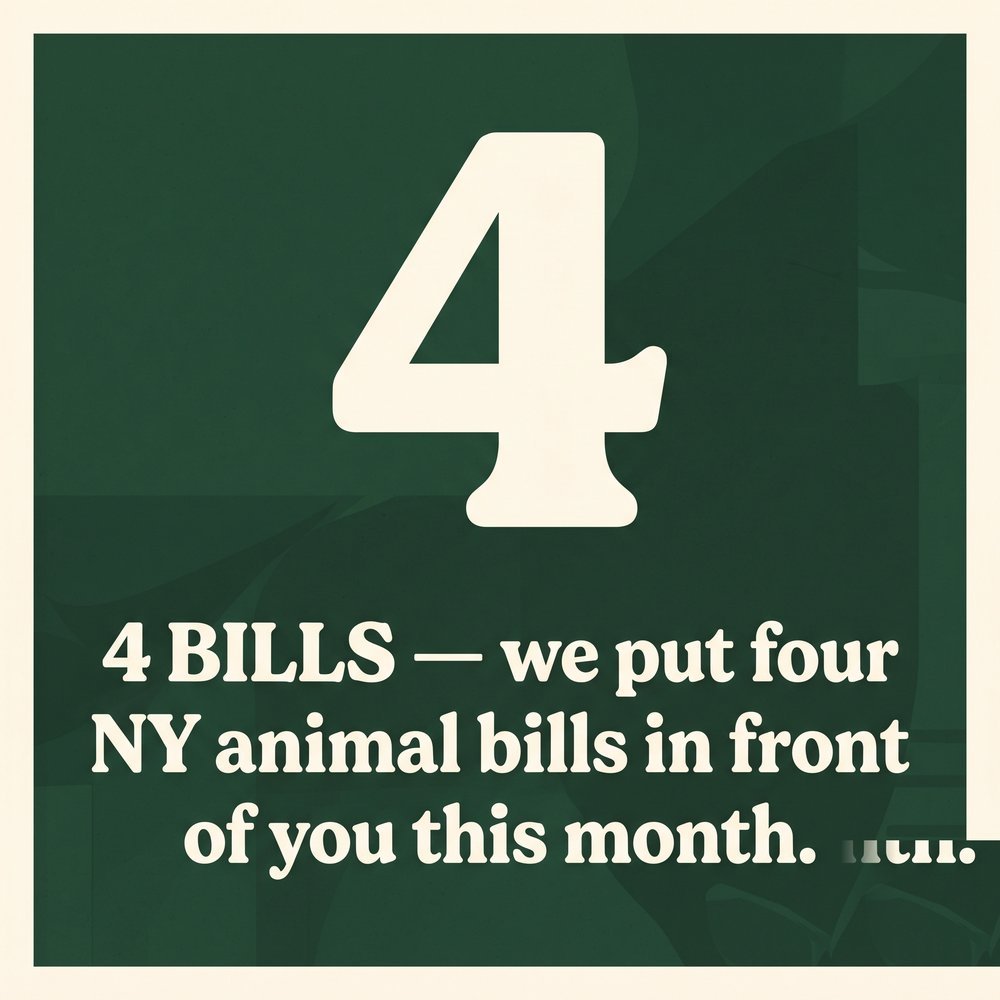
June wasn't loud, but it added up. We put four New York animal bills in front of you — octopus farming, wild animals in traveling acts, breed discrimination in renters' insurance, and the federal fight over Prop 12. We handed the mic to the orgs doing the unglamorous work. We introduced you to sanctuaries a short drive from your apartment.
None of that is ours. It's yours — every call to Albany, every share, every friend you sent a post to instead of an argument. Advocacy isn't a personality; it's a stack of small, ordinary actions, and you stacked them.
July's calendar is already filling up. Same time, same place. Thanks for being here. 💚
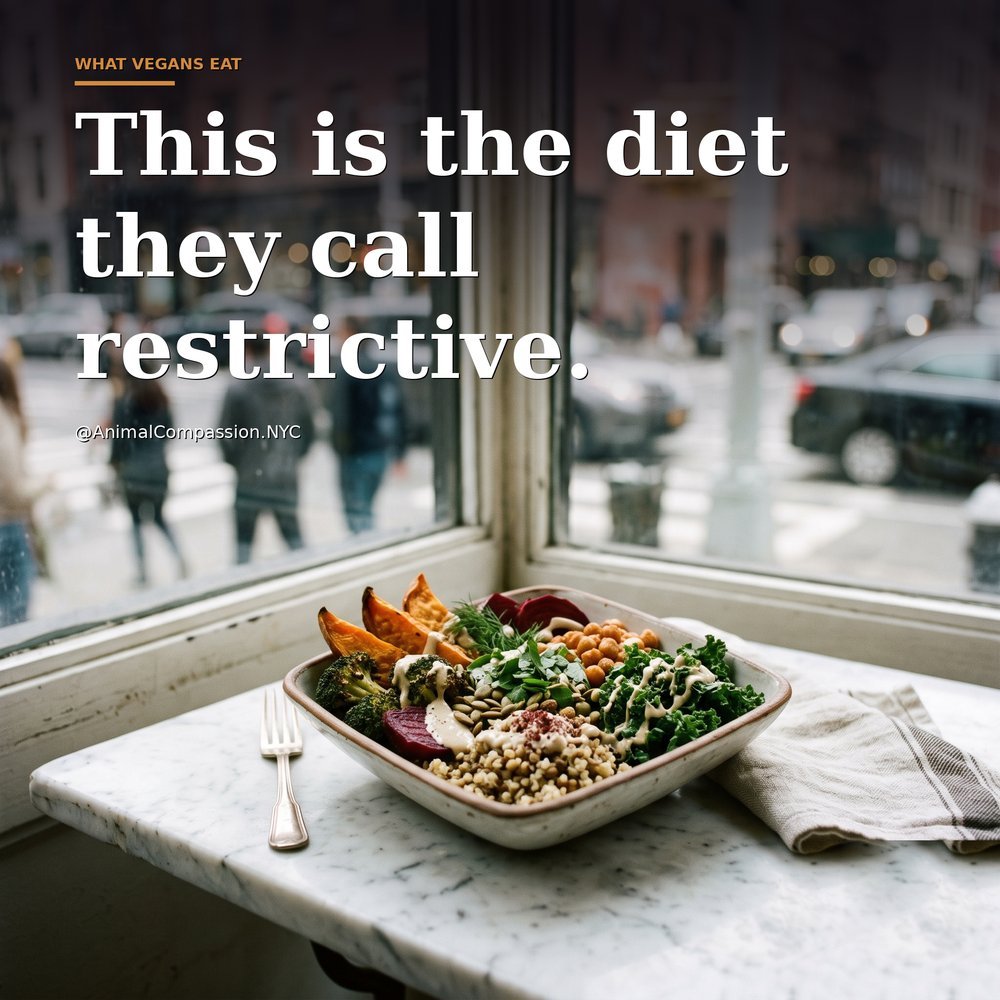
Eating this way in this city was supposed to be the hard part. It turned out to be the easy part.
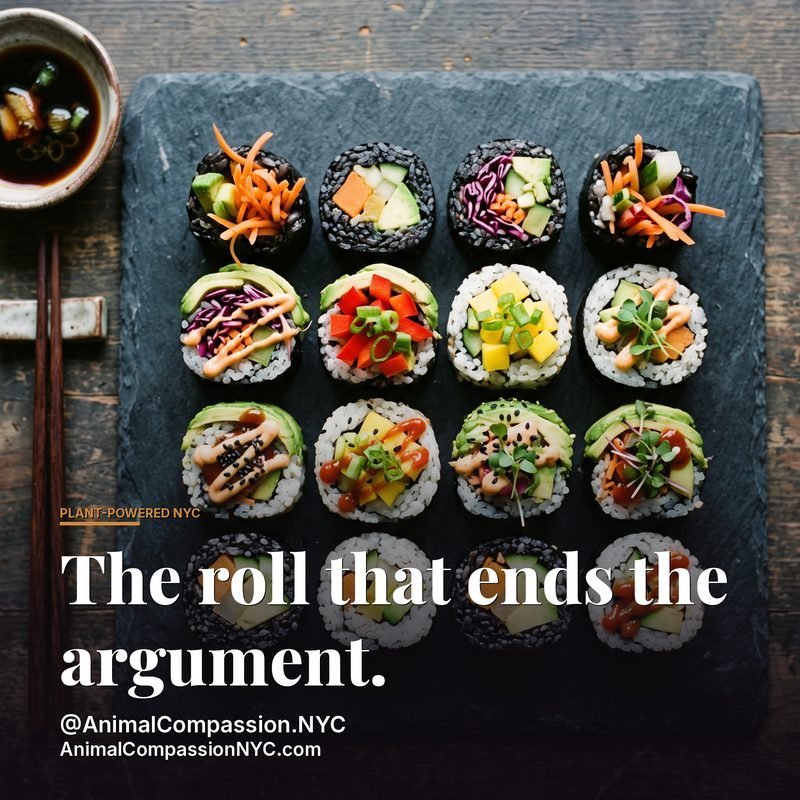
Somewhere along the way the story flipped. Going plant-based in New York isn't a sacrifice you white-knuckle through — it's a standing reservation at a thousand places that are genuinely, stop-mid-sentence good. The hard part was never the food. It was the story we'd been told about the food.
Whatever's on the plate today, no animal had to be negotiated with to put it there. That's not a guilt trip — it's the quiet pleasure of the thing.
Your turn: what's the NYC dish that ended someone's "I could never" for good? Tell us in the comments.
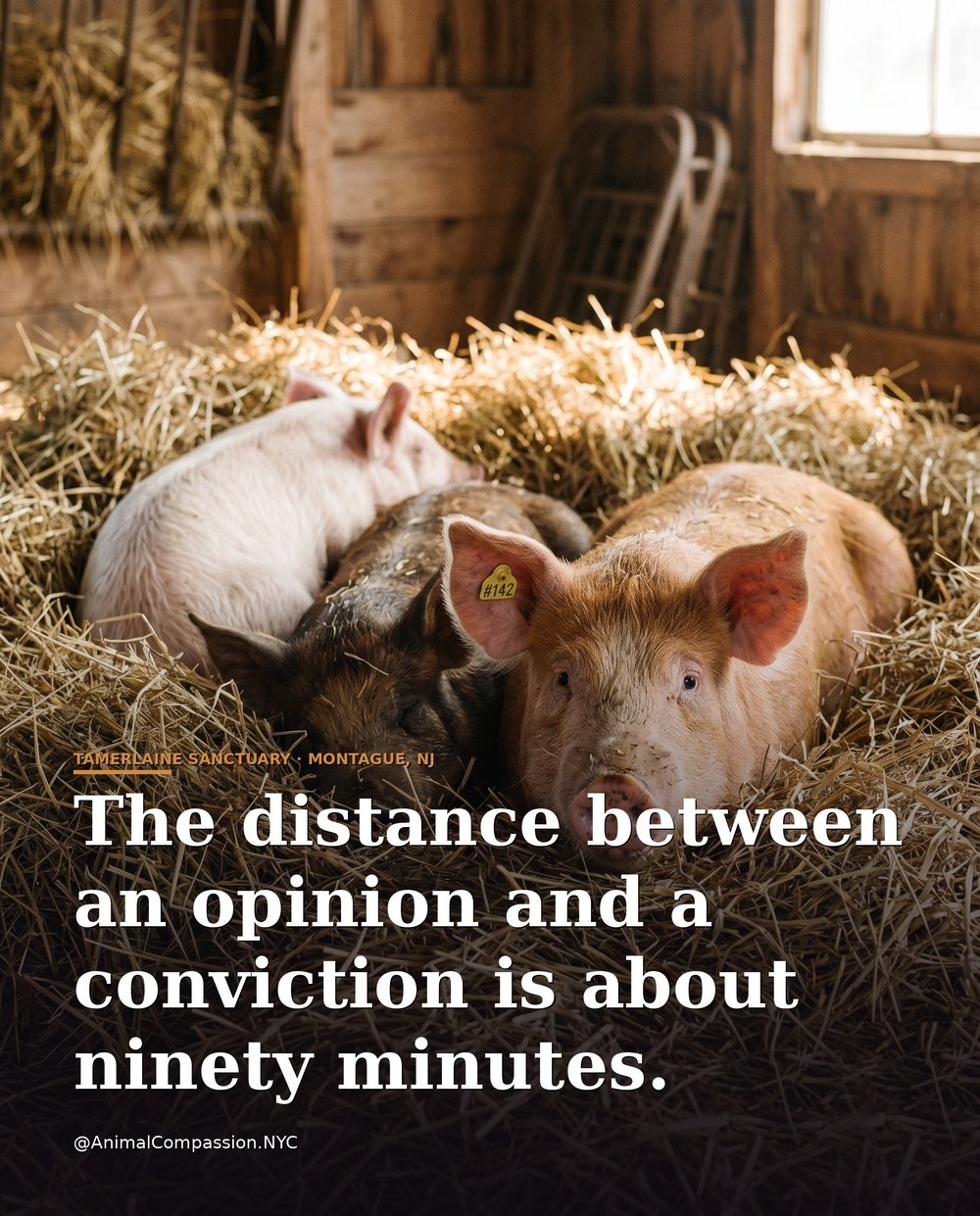
The distance between an opinion and a conviction is about ninety minutes.
That's the drive from the city to Tamerlaine Sanctuary in Montague, New Jersey — the closest major farm sanctuary to NYC. It's one thing to believe, in the abstract, that a pig is someone. It's another to sit in the hay while one leans her whole weight against your leg and sighs.
Most of us have never met the animals we have opinions about. The pork is shrink-wrapped; the pig is a cartoon on the label. Meet a real one — with a name and a favorite patch of sun — and the abstraction collapses into a face.
Spend an afternoon there this summer. Bring the kids; bring the skeptic in your life. Visit and volunteer info.
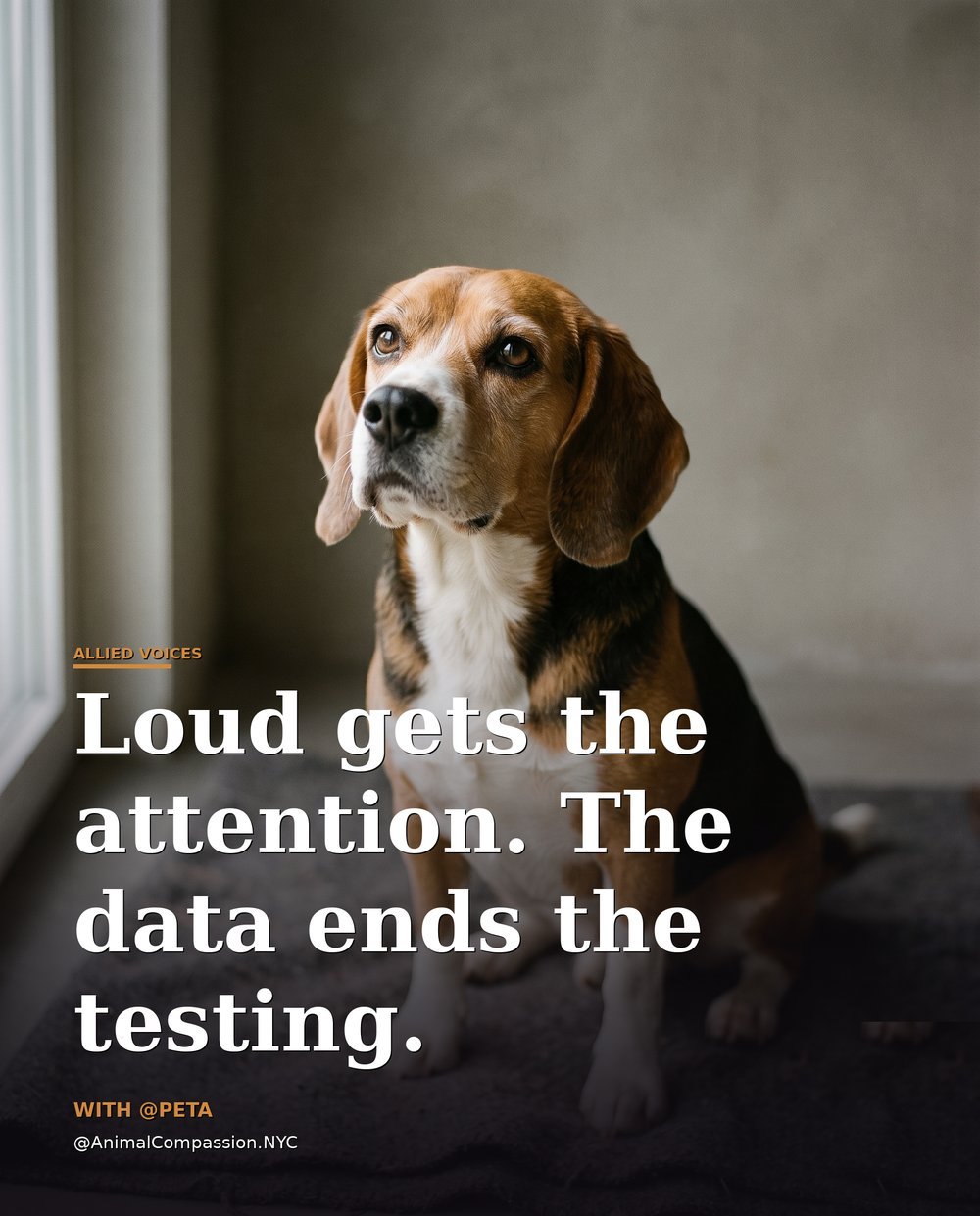
PETA is the easiest animal-rights group in the world to roll your eyes at. It's also one of the few that does the unglamorous part.
The unglamorous part is the data. The paint, the protests, the billboards — that's the volume that gets the attention, and it's exactly what makes people tune out. But behind the noise, PETA's scientists publish the Research Modernization Deal: a step-by-step roadmap for replacing animal tests with organs-on-chips, human-cell assays, and computer models. Regulators read the roadmap, not the shock.
And it's moving. The FDA Modernization Act 2.0 ended the federal mandate that every new drug be tested on animals first. The FDA has since asked the pharmaceutical industry to start retiring its dogs, primates, and pigs, and this spring the NIH put $150 million behind non-animal methods. Those are the moves that empty the cages.
It was also PETA's 2021 undercover investigation of the Envigo breeding mill that ended with nearly 4,000 beagles walking out of a Virginia facility and into homes instead of experiments.
Credit where it's due, @peta — loud gets the attention, but the data ends the testing. Follow the people doing the boring, decisive work.